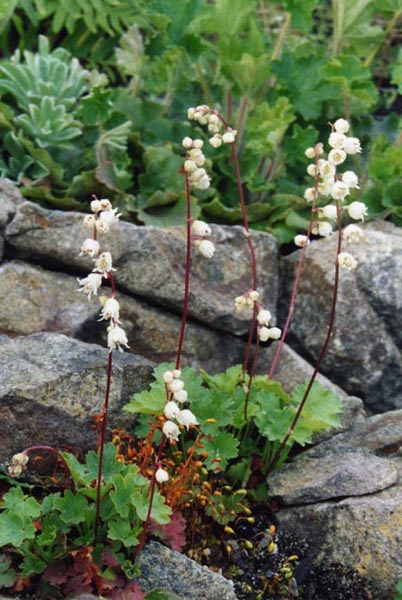
Perennial of the Saxifragaceae family, Heuchera hallii is an endemic species of the Colorado Rockies, where it grows in granite rock crevices, scree, and exposed rocky slopes, generally between 2,800 and 3,800 meters in altitude. It is one of the most distinctly alpine Heuchera of the genus.
It forms small, very compact basal clumps, 10 to 20 cm in foliage height, with cordate leaves, deeply lobed and toothed, bright and shiny green, with a slightly leathery texture. Slender, reddish flowering stems rise from the clump, 20 to 35 cm, bearing loose and graceful clusters.
The flowers are small, globular, pure white to pinkish white, covered with a fine glandular pubescence that gives them a very distinctive fluffy appearance, almost cottony in backlight. This fluffy texture of the swollen calyxes is the most immediately distinctive feature of the species, clearly visible with a magnifying glass or in raking light.
In its natural habitat, its flowering extends from June to August depending on the altitude. In cultivation, it requires perfect drainage, a lean and mineral substrate, a sunny to cool semi-shade exposure. It is particularly suited to carefully maintained alpine rock gardens and crevice cultures, and suffers from any excess stagnant moisture in winter.