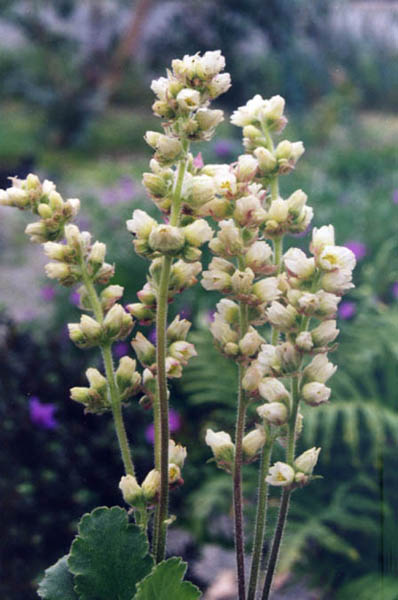
Perennial of the Saxifragaceae family, Heuchera cylindrica is native to the western part of North America, from the Rockies to the Pacific coast, from Montana to British Columbia. It occupies rocky slopes, cliffs, scree, and dry high-altitude meadows, often on well-drained basaltic or granitic substrates.
It forms compact basal clumps of cordate, distinctly lobed and toothed leaves, with a matte green slightly veined surface, moderately hairy. The flowering stems, robust, upright, finely glandular, rise to 50-70 cm, bearing rather loose branched clusters whose habit vaguely resembles that of a small astilbe.
The flowers are small, tubular to campanulate, cream-white to pale yellow-greenish, slightly tinged with pink at the base of the sepals. They are grouped in loose glomerules along branched stems, which clearly distinguishes this species from Heuchera with strict spikes like H. chlorantha. The swollen and rounded calyces, well visible, give the inflorescence a very characteristic grainy and airy texture.
In its natural habitat, its flowering extends from May to July. In cultivation, it is particularly hardy and tolerant of summer drought, which is rare in the genus. It requires well-drained soil, in full sun or light partial shade, and is perfectly suited to rock gardens and gravel gardens.