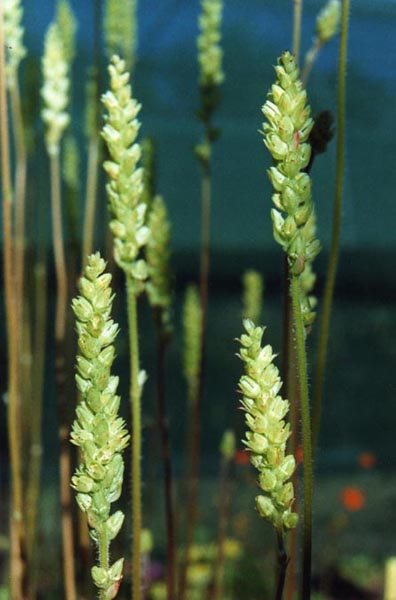
A perennial of the Saxifragaceae family, Heuchera chlorantha is native to the Pacific coast of North America, from northern California to British Columbia. It naturally grows in open forests, rocky edges, and moist to cool grassy slopes, often at moderate altitude, on various substrates.
It forms basal clumps of cordate, lobed, medium green leaves, semi-persistent, with a slightly hairy surface. From these clumps rise numerous slender, erect, reddish, and finely glandular stems during flowering, reaching 60 to 80 cm in height, bearing elongated and dense spikes.
It is precisely this inflorescence that distinguishes the species: the flowers are entirely green, small, tubular, tightly packed along the floral axis in strict and regular cylindrical spikes, of a very particular pale yellow-green. The epithet chlorantha — "with green flowers" — exactly describes this characteristic, rare in the genus. The contrast between the purple stems and the tender green spikes is quite remarkably sober.
In its natural habitat, its flowering extends from May to July. In cultivation, it appreciates fresh, well-drained, humus-rich soil, in partial shade or filtered light. It tolerates full sun if the soil remains sufficiently cool. A discreet plant but with a very particular elegance for naturalistic compositions.