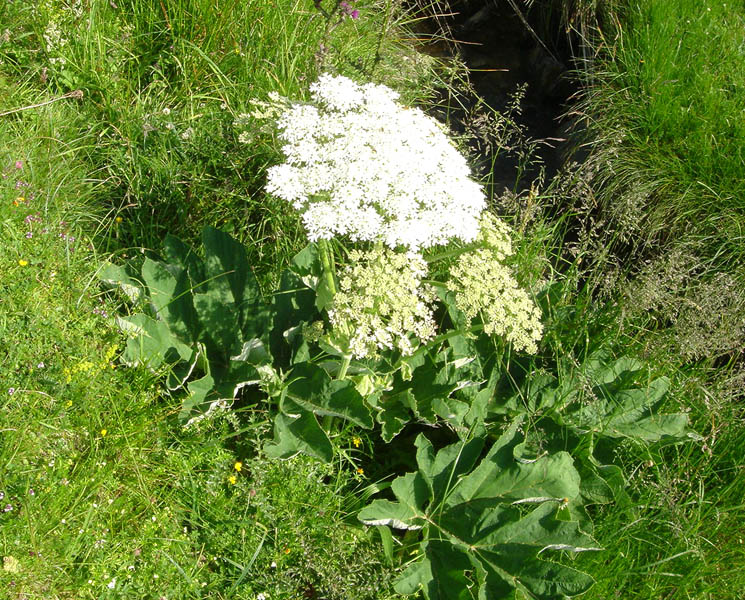
photographed in the Pyrenees
photographed in the Pyrenees
Perennial of the Apiaceae family, Heracleum pyrenaicum is a species endemic to the Pyrenees and the mountains of the northern Iberian Peninsula. It occupies high-altitude megaphorbia, stream banks, wet meadows, and grassy hollows, generally between 1,200 and 2,200 meters of altitude, on fresh to moist substrates, rich in organic matter.
It forms powerful upright clumps 60 to 120 cm in height, with robust, hollow, and striated stems. The leaves are large, with a lobed and toothed blade, a bright green, softly hairy on both sides, with a petiole strongly dilated into a sheath at the base, a typical characteristic of large mountain Apiaceae.
The inflorescence is a large compound umbel, very ample, which can exceed 20 cm in diameter, bearing many small pure white flowers. The peripheral flowers of each umbellule have significantly larger, radiating outer petals, giving the whole an aspect both dense and airy, very characteristic of the genus.
In its natural habitat, its flowering extends from July to August. The young shoots and petioles are traditionally consumed in the Pyrenees, where the plant is appreciated for its characteristic aromatic flavor.
In cultivation, it requires a deep soil, constantly fresh to moist, rich in humus, in full sun or light partial shade. It is suitable for large naturalistic gardens and the banks of bodies of water.