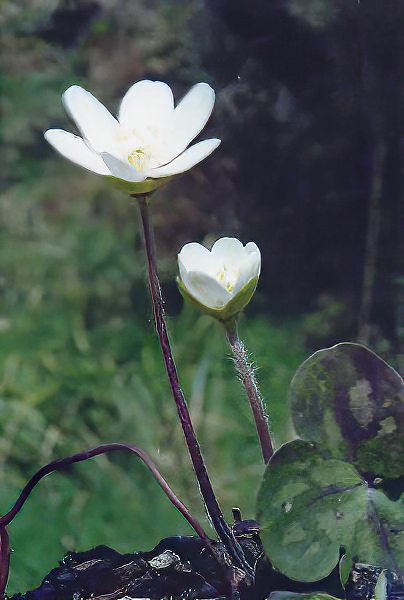
Perennial of the Ranunculaceae family, Hepatica triloba is widespread in much of Europe, from the Iberian Peninsula to western Russia, as well as in temperate Asia and North America. It inhabits deciduous and mixed undergrowth, shaded edges, and wooded slopes, preferably on calcareous or neutral soils, rich in humus, from the plains up to about 1,600 meters in altitude.
It forms small, low, and persistent clumps, hardly exceeding 10 to 15 cm in height when in bloom. The leaves, trilobed as its name suggests, are leathery, dark green often marbled or tinged with purple-brown on the upper side, and more distinctly purplish underneath, especially in winter and spring. This dark winter coloration, reminiscent of the shape of a liver, is the origin of the generic name Hepatica.
The flowers, solitary, are borne on slender, erect, and hairy peduncles. They have six to nine petaloid sepals — the true petals being absent in the Ranunculaceae — surrounding a center of cream-white stamens. The form photographed here is white, but the species is also found in blue-lilac, pink, and violet depending on the populations.
In its natural habitat, its flowering extends from February to April, often even before the full deployment of new leaves. In cultivation, it blooms from February in mild climates.
It requires well-drained, cool, humus-rich soil, in shade or partial shade, preferably calcareous. Once established, it self-seeds spontaneously and gradually forms beautiful carpets.