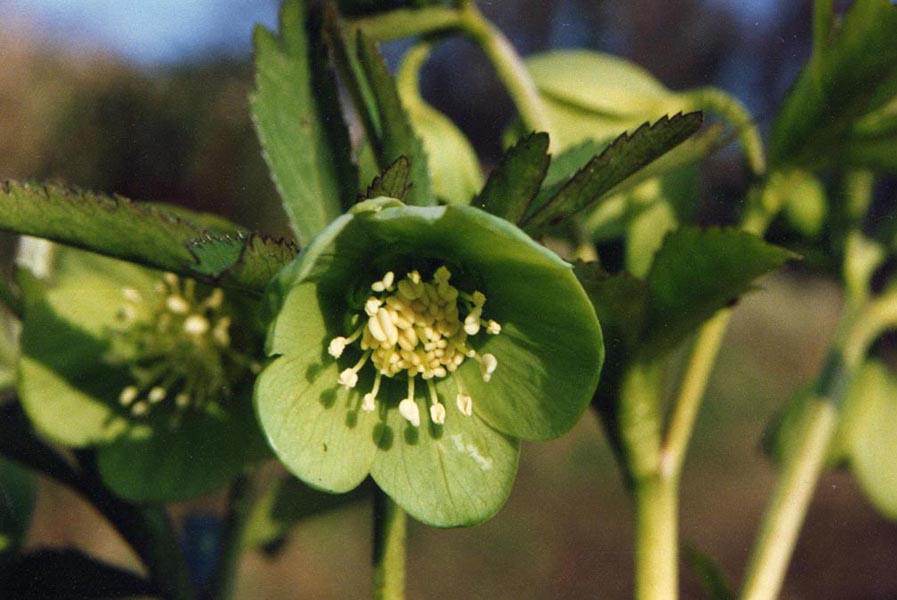
Perennial of the Ranunculaceae family, Helleborus viridis is present in a large part of Western and Central Europe, from England to Italy and the Balkans. It grows in cool and shaded deciduous undergrowth, ancient hedgerows, damp edges, and wooded banks, generally on calcareous soils rich in humus, from the plains up to about 1,500 meters in altitude.
It forms sparse clumps, with upright stems 20 to 40 cm high, deciduous or semi-evergreen depending on the climate, which distinctly sets it apart from most other cultivated hellebores whose foliage is evergreen. The leaves, long-petioled, are palmate, divided into lanceolate and finely toothed segments, of a slightly glaucous matte green, without the characteristic shine of Helleborus argutifolius.
The flowers, borne in sparsely furnished cymes of two to four nodding heads, are open cup-shaped, of a bright and sustained green, without whitish or purplish hues. This pure and discreet green, almost vegetal, is one of the most singular characteristics of the species within the genus. Like all hellebores, the plant is toxic in all its parts.
In its natural habitat, its flowering extends from February to April depending on altitude and exposure. In cultivation, it generally occurs from February to March.
It requires a cool, deep, humus-rich soil, well-drained but without prolonged dryness, in shade or partial shade. It is suitable for woodland gardens and naturalistic compositions on calcareous soil.