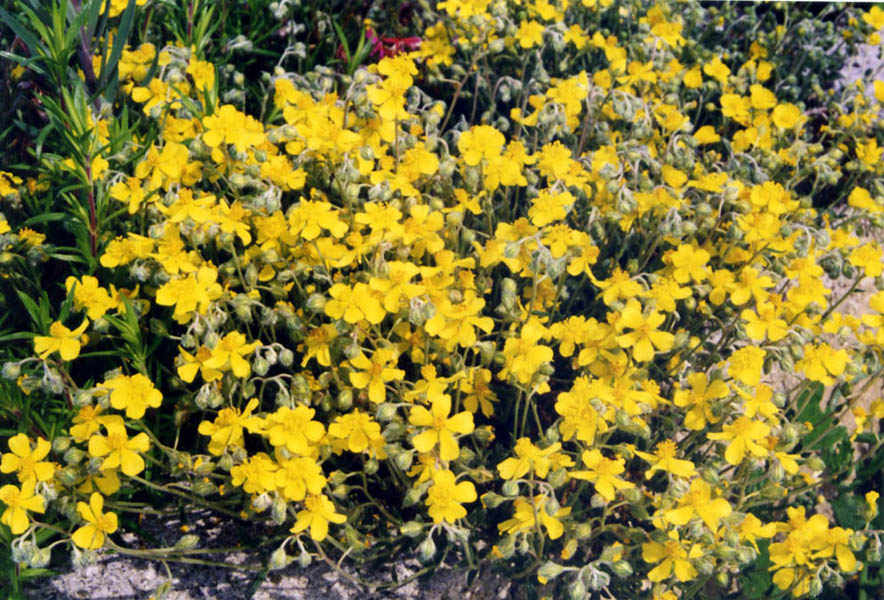
Perennial sub-shrub of the Cistaceae family, endemic to the Iberian Peninsula, where it occupies dry grasslands, open garrigues, and rocky limestone slopes of the Spanish interior, at low and medium altitudes. It is part of the yellow-flowered helianthemums of the Mediterranean section of the genus, a group still insufficiently known to gardeners.
It forms a sprawling and generous clump, 20 to 35 cm in height, with numerous, flexible, and arched stems, densely covered with a grayish indumentum that gives the whole a velvety and silvery appearance between the waves of flowering. The leaves are small, narrow to oval, gray-green, tomentose on both sides.
The flowers are a bright and vivid yellow, with five well-opened petals, borne in loose and very numerous clusters that literally cover the clump at the peak of flowering. The profusion of grayish buds mixed with open flowers creates a very particular texture effect, both downy and dazzling. In its natural habitat, its flowering extends from April to June.
In cultivation, it requires very well-drained soil, poor to moderately calcareous, in full sun exposure, with a well-marked summer drought. It does not tolerate overly wet winters in heavy soil. A light pruning after flowering maintains the compactness of the clump.