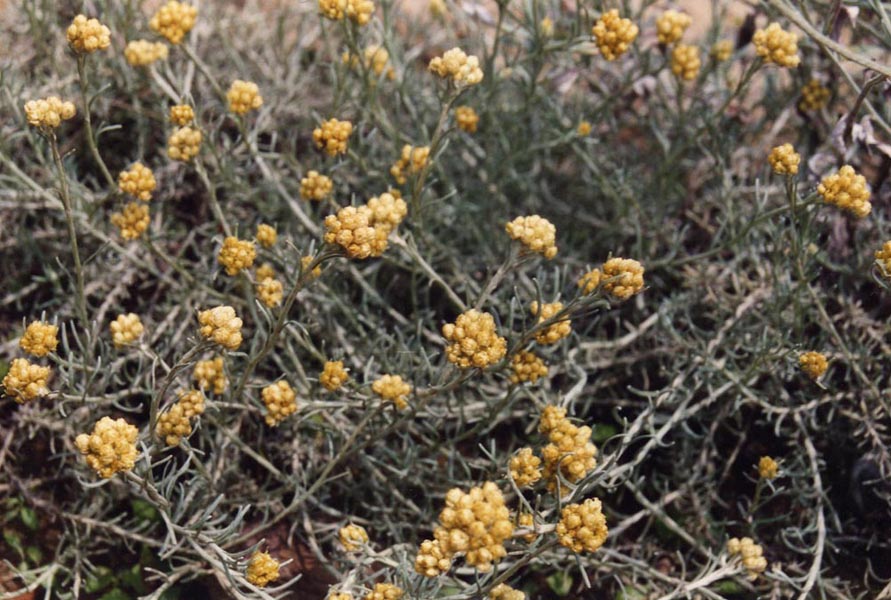
Helichrysum stoechas is a sub-shrub of the Asteraceae family, widely spread around the Mediterranean basin and the Atlantic coasts up to the Basque Country, where it colonizes dunes, open garrigues, calcareous or siliceous rocky areas, coastal cliffs, and sunny sandy slopes, from sea level to medium altitudes.
It usually forms a loose to semi-dense bush, 20 to 50 cm in height, with whitish, woolly stems bearing very narrow, linear leaves, rolled at the edges, of a silvery gray-green. On coastal cliffs exposed to permanent salt-laden winds, such as on the Basque corniche, the plant can adopt a very particular covered and contracted habit in winter and early spring: the leaves, extremely tight and short, with starry whitish tips, then form dense cushions with an almost mineral appearance, hardly observed in ordinary cultivation.
The flower heads are small, bright and shiny yellow, grouped in abundant corymbs that generously cover the plant at the time of flowering. In its natural habitat, its flowering extends from April to July depending on the locality and exposure.
The plant emits a powerful and characteristic aroma, blending curry and resinous notes, particularly noticeable in hot weather. It has been used in traditional medicine for its expectorant and antiseptic properties.
In cultivation, it requires full sun and very well-drained soil, dry in summer, and tolerates both limestone and siliceous sand. Hardy to about -12°C in dry conditions, it is suitable for rock gardens, coastal gardens, and xeric compositions.