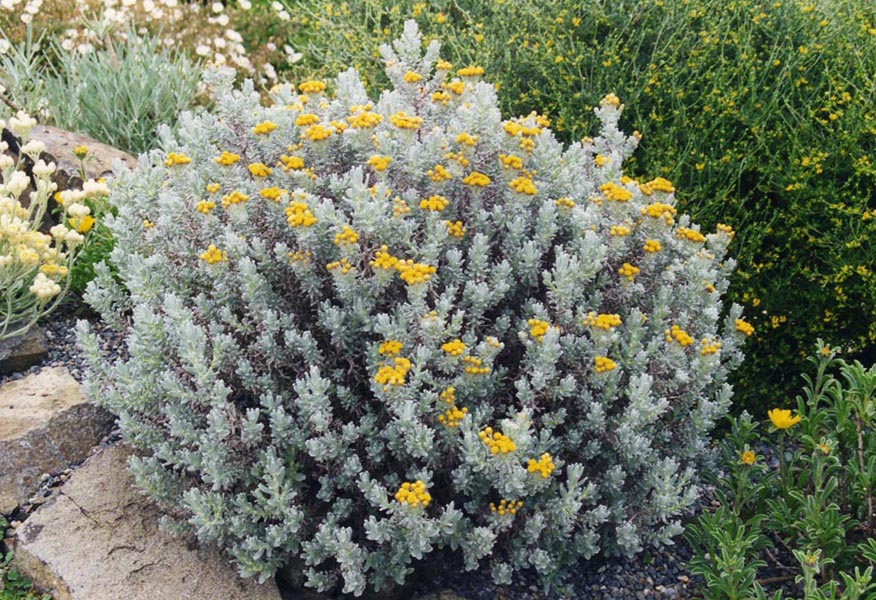
Helichrysum splendidum is a sub-shrub of the Asteraceae family, native to South Africa and East Africa, where it colonizes rocky slopes, cliff edges, and open shrublands, often at mid to high altitudes in mountainous areas.
It forms a dense and rounded bush, very branched, reaching 60 to 100 cm in height and as much in spread. The entire plant, stems and leaves, is covered with an extremely dense silvery white tomentum that gives it a bright gray-white color, almost lunar, remarkably uniform throughout the season. The leaves are small, spatulate to slightly lobed, tight along the upright stems, and their woolly texture catches the light in a very particular way.
The flower heads are small, bright and vivid yellow, grouped in compact corymbs at the top of the branches. Entirely tubular, they stand out brilliantly against the silvery foliage. In its natural habitat, flowering extends from spring to the southern summer. In cultivation under our latitudes, it generally occurs from June to September, sometimes longer in mild climates.
It is used in traditional medicine in southern Africa, notably for its antimicrobial and anti-inflammatory properties, under the vernacular name of three-leaved everlasting.
It requires full sun and very well-drained soil, tolerates drought and withstands down to about -8°C in dry conditions. Its silvery silhouette makes it a remarkable structural element in dry garden compositions, large rockeries, and Mediterranean gravel gardens.