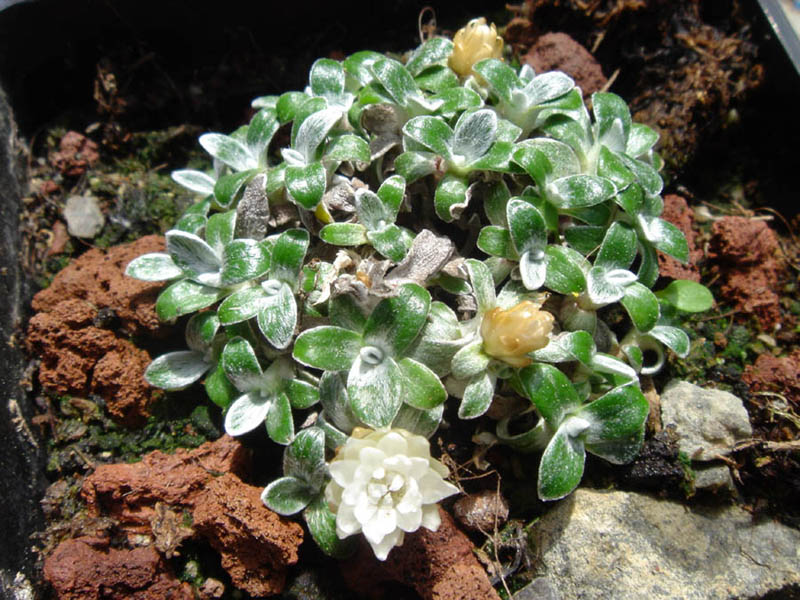
Helichrysum sessilioides is a perennial from the Asteraceae family, native to New Zealand, where it occupies the alpine and subalpine zones of the South Islands, on rocks, scree, and windy ridges, generally above 1,200 meters in altitude.
It forms a dense and very compact cushion, only a few centimeters high, composed of small spatulate to oval leaves, sessile, closely imbricated. The foliage is a bright green on the upper side, sharply contrasted by a silvery white tomentose underside and margins, giving the entire cushion a very graphic bicolored appearance, almost lustrous in the light. The leaves have a slightly leathery texture and their slightly wavy edges accentuate this play of shadow and light between the two sides.
The flower heads are borne directly at the level of the foliage, sessile or almost sessile as the species name indicates. They are white to cream white, initially globular and yellowish in bud, then opening into small papery flowers tightly packed, sitting directly on the cushion without an apparent stem. In its natural environment, the flowering extends from December to February. In cultivation in our latitudes, it occurs in summer.
It requires full sun, a very well-drained and mineral substrate, with protection against stagnant winter moisture. Hardy to moderate frosts in dry conditions, it is ideally cultivated in a carefully maintained alpine rock garden or in a container under cold shelter in winter. A collector's plant whose compactness and bicolored foliage alone justify all the attention it deserves.