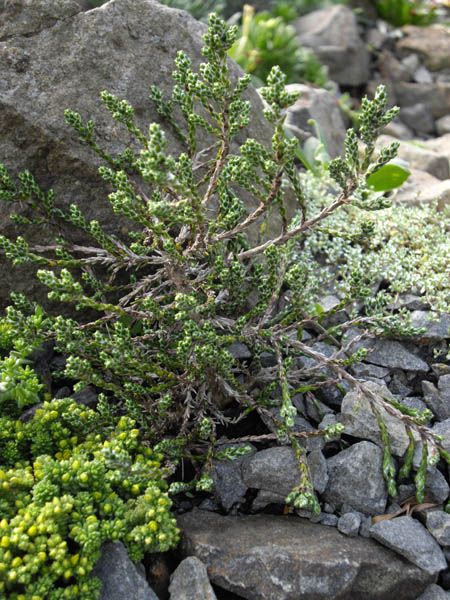
(Helichrysum selago var tumidum)
(Helichrysum selago var tumidum)
Helichrysum selago var. tumidum is a sub-shrubby perennial of the Asteraceae family, endemic to New Zealand, where it grows in the alpine and subalpine zones of the South Islands, on rocks, scree, and exposed ridges above 1,000 meters in altitude.
It forms a small, spreading, branched bush with a woody base and gray to brown stems as they age, bearing upright or slightly arched branches about fifteen centimeters long. What immediately strikes is the absolutely unique texture of its leafy stems: the leaves are very small, oval, swollen, fleshy, bright green, closely overlapping and wrapped in a white felt between them, creating a green and white checkerboard pattern of almost geometric precision. This aspect is more reminiscent of coral, a lycopod, or a construction toy than what one expects from a flowering plant. The variety tumidum is distinguished from the type form and the variety macrophyllum by its significantly more swollen and convex leaves, making the bicolored pattern even more contrasting and sculptural.
The flower heads are tiny, whitish to pale cream, borne at the ends of branches. In its natural habitat, flowering extends from December to February, the austral summer. In cultivation in our latitudes, it is exclusively the foliage that justifies the place given to this plant.
It requires full sun, a very mineral and perfectly drained substrate, and constant ventilation. It does not tolerate stagnant winter moisture and only withstands light frosts. A pure collector's plant, it fascinates both botanists and enthusiasts of unusual plant forms.