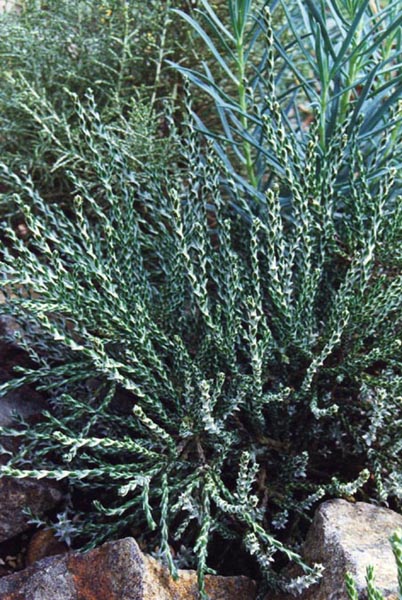
+ Dianthus fruticosus
(Helichrysum selago var macrophyllum + Dianthus fruticosus)
+ Dianthus fruticosus
(Helichrysum selago var macrophyllum + Dianthus fruticosus)
Helichrysum selago var. macrophyllum is a perennial from the Asteraceae family, endemic to New Zealand, where it occupies rocks, ridges, and screes in the alpine and subalpine zones of the South Islands, generally above 1,000 meters in altitude.
It forms a spreading bush in a radiant rosette, with upright to slightly arched stems, starting from a central woody base. The stems are densely covered with small imbricated leaves, applied and twisted on themselves, leathery, dark green on the upper side and distinctly white tomentose on the underside and margins. This alternation of dark green and white creates a very characteristic bicolored spiral effect on each stem, immediately recognizable, unlike any other cultivated everlasting. The variety macrophyllum is distinguished from the type form by its more developed leaves, making this effect even more pronounced.
The capitula are small, white to cream, borne at the ends of branches. In its natural habitat, flowering extends from December to February, the austral summer. In cultivation under our latitudes, it blooms in summer, but it is the structure of the leafy stems that constitutes the primary attraction of the plant.
It requires full sun, a very well-drained mineral substrate, and good ventilation. It fears stagnant winter humidity and only tolerates moderate frosts. It is a collector's plant strictly reserved for enthusiasts of southern hemisphere alpine flora.
Dianthus fruticosus is a sub-shrubby perennial from the Caryophyllaceae family, native to Greece, where it is confined to the Aegean islands, notably Milos, Sifnos, and a few neighboring Cyclades islands. It grows on coastal cliffs, limestone rocks, and very exposed rocky slopes, often swept by sea winds, from sea level to modest altitudes.
It forms a small, branched, dense shrub, 30 to 60 cm in height, with woody stems at the base bearing tufts of linear to linear-lanceolate leaves, glaucous, blue-green, leathery, persistent. This silvery and rigid foliage gives it a beautiful appearance outside of any flowering and remarkable resistance to drought and wind.
The flowers are large for the genus, bright pink to fuchsia pink, with deeply cut and fringed petals at their margin, characteristic of carnations. They are borne in small terminal groups on upright stems rising above the foliage and emit a discreet fragrance. In its natural habitat, flowering extends from May to July. In cultivation, it can last longer with a very warm exposure.
It requires full sun, a perfectly drained soil, preferably limestone, and withstands summer drought well once established. Its hardiness is limited to mild winters, around -8 to -10°C in dry conditions. It is perfectly suited to Mediterranean rock gardens, walls, and gravel gardens in mild climates.