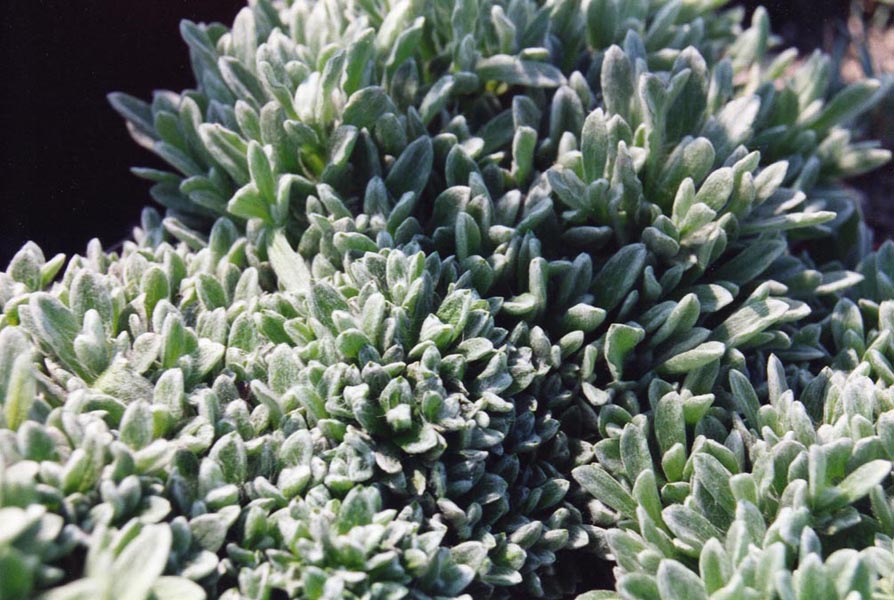
Helichrysum plicatum ssp. plicatum is a perennial from the Asteraceae family, native to the Balkans and western Turkey, where it grows on dry lawns, limestone rocks, and sunny rocky slopes, generally between 500 and 1,800 meters in altitude. It belongs to a group of compact-leaved immortelles highly valued in rock garden cultivation.
It forms a low, dense tuft, almost cushion-like, 10 to 15 cm in height outside of flowering, composed of small linear to oblong leaves, grayish-green to dark green on the upper side, tomentose and whitish underneath, tightly arranged along woody stems at the base. The name plicatum refers to the pleated venation or the slightly folded arrangement of the leaves. The contrast between the dark foliage and the gray, erect floral stems is one of the plant's most elegant aspects.
The floral stems, slender, erect, significantly taller than the foliage, bear bright yellow, dense, rounded capitula, grouped in very distinct small terminal corymbs. In its natural habitat, flowering extends from June to August. In cultivation, it generally occurs in June-July.
It requires full sun and well-drained soil, preferably stony, low in organic matter. It tolerates limestone and withstands moderate cold of around -10 to -15°C in dry soil. Winter moisture is its main constraint. It is a robust and reliable species for rock gardens and sun-exposed walls.