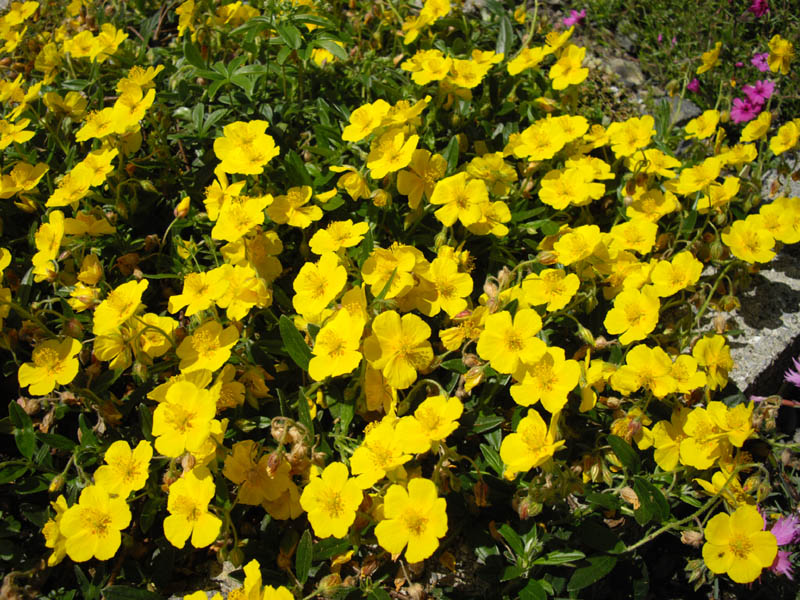
Perennial subspecies of the Cistaceae family, found in the mountainous regions of Central and Southern Europe, from the Alps to the Carpathians and the Apennines. It inhabits high-altitude limestone grasslands, stabilized scree, and sun-exposed rocky slopes, generally between 1,200 and 2,400 meters, where it gradually replaces the type subspecies in the subalpine and alpine zones.
It is distinguished from the type species by its noticeably larger flowers, with broader and more developed petals, of a bright and luminous yellow, borne in dense clusters that can abundantly cover the tuft at flowering time. The foliage consists of small oval to elliptical leaves, dark green and shiny on the upper side, significantly paler underneath, giving the plant a neat and contrasting appearance.
The tuft is bushy and spreading, 10 to 30 cm in height, dense and well-branched, often leaning against rocks or insinuating itself into the crevices of limestone slabs.
In its natural habitat, its flowering extends from June to August depending on the altitude. In cultivation, it occurs from May to July.
It requires well-drained soil, preferably limestone, in a sunny position. Perfectly hardy, it is excellently suited to naturally designed rock gardens and mountain-inspired gardens, where its large yellow flowers bring a particularly generous brightness to the genus.