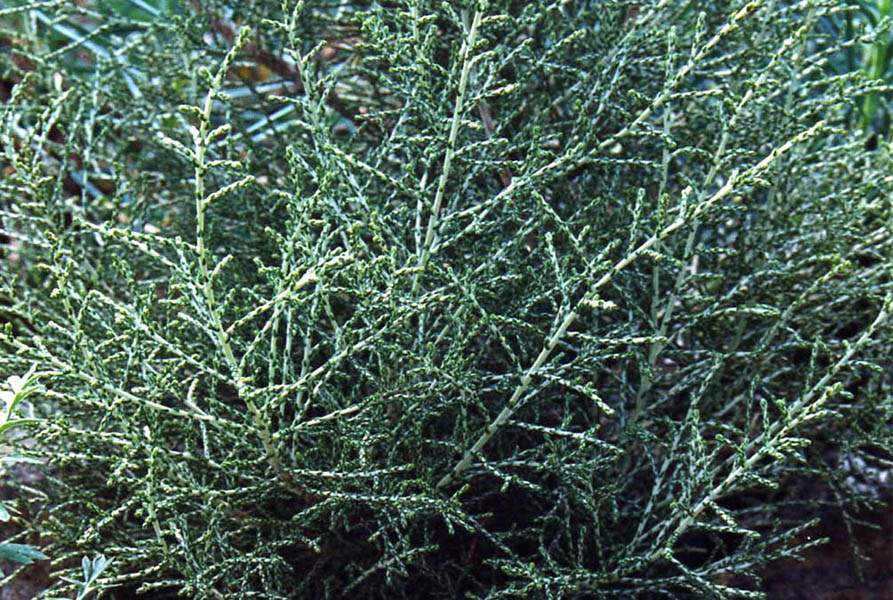
(Helichrysum hoockeri)
(Helichrysum hoockeri)
Sub-shrub of the Asteraceae family, Helichrysum hookeri is native to Australia, where it grows on rocky slopes, dry heaths, and moderate altitude areas of the southeastern states, notably in New South Wales and Victoria.
The plant forms an upright and dense bush, reaching 50 to 80 cm in height. What immediately strikes is the extreme fineness of its branches: the stems subdivide into increasingly slender, almost filiform branches, covered with very small, tightly applied scale-like leaves, dark green to slightly glaucous. The whole irresistibly evokes certain conifers with scaly foliage, like cypresses or thujas, and this deceptive resemblance is one of the most unusual aspects of the Helichrysum genus.
The flower heads are small, yellow, borne at the end of the branches. In its natural habitat, flowering mainly extends over the austral spring, from October to December. In cultivation under our latitudes, it occurs from late spring to early summer.
It requires a very well-drained soil, poor to moderately fertile, in full sun. Its frost resistance remains limited and winter protection is advised in regions with marked cold.