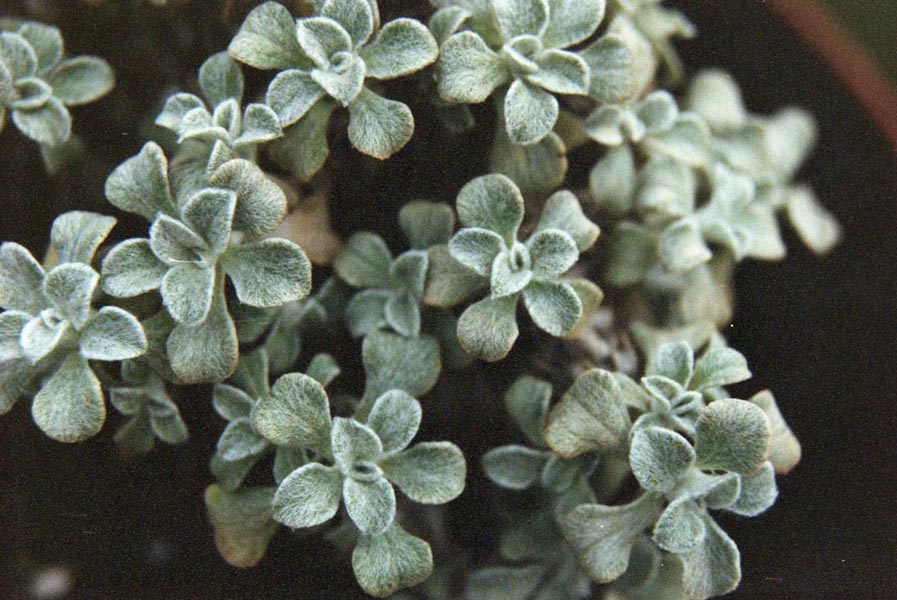
Perennial of the Asteraceae family, Helichrysum confertum is native to South Africa, where it grows on the rocky slopes and scree of the Cape mountains and interior massifs. Its Latin epithet, meaning "tight, dense," perfectly describes the compact and clustered architecture of the plant.
It forms a small subshrub in a dense and rounded cushion, 10 to 20 cm in height, with short, very branched stems. The foliage is its main attraction: very small oval to obovate leaves, arranged in tight terminal rosettes along the stems, entirely covered with a velvety gray-silver to ash-white tomentum, of a soft and uniform texture. Seen up close, these leafy rosettes evoke tiny bouquets sculpted in felt, with great ornamental regularity.
The capitula are small and discreet, yellow, borne at the end of the branches. In its natural habitat, flowering extends at the end of the dry season, generally from November to January. In cultivation under our latitudes, it occurs in summer, but it is the texture and silvery color of the persistent foliage that make the main interest of this species throughout the year.
It requires a very well-drained, poor soil, in full sun, and does not tolerate stagnant moisture in winter. Hardy to about -8 °C in dry conditions, it is often grown in pots or containers in regions with rainy winters. A light pruning after flowering maintains the compactness of the habit.