Perennial of the Asteraceae family, Helichrysum arenarium is widespread in Central and Eastern Europe, from Eastern France to Western Siberia, with notable presence in Southern Scandinavia, Germany, Poland, and the Baltic countries. As its epithet indicates, it is confined to sandy environments: dry lawns on sand, open heaths, edges of sandy paths, edges of pine forests on poor siliceous soils, always in full light and well-drained situations.
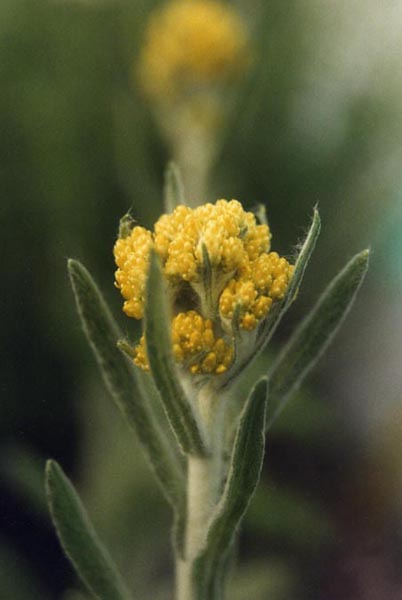
The plant forms a low and upright tuft, 15 to 30 cm in height, entirely covered with a whitish-gray woolly tomentum giving it a characteristic downy appearance. The leaves are oblong to spatulate, sessile or shortly petiolate, gray-greenish on both sides.
The inflorescences are gathered in dense and tight corymbs, composed of numerous small globular capitula of bright yellow to orange-yellow, with persistent and shiny scarious bracts. In its natural habitat, its flowering extends from July to September. In cultivation, it occurs from June to August. The dry capitula retain their color for several months, making it a plant traditionally harvested for dry bouquets.
In Central Europe, this species is protected in several countries due to the rarity of open sandy environments. It is cultivated in very well-drained, sandy, poor soil, in full sun, without excessive watering. It is suitable for pebble rock gardens, sand gardens, and compositions with a natural and steppe-like character.