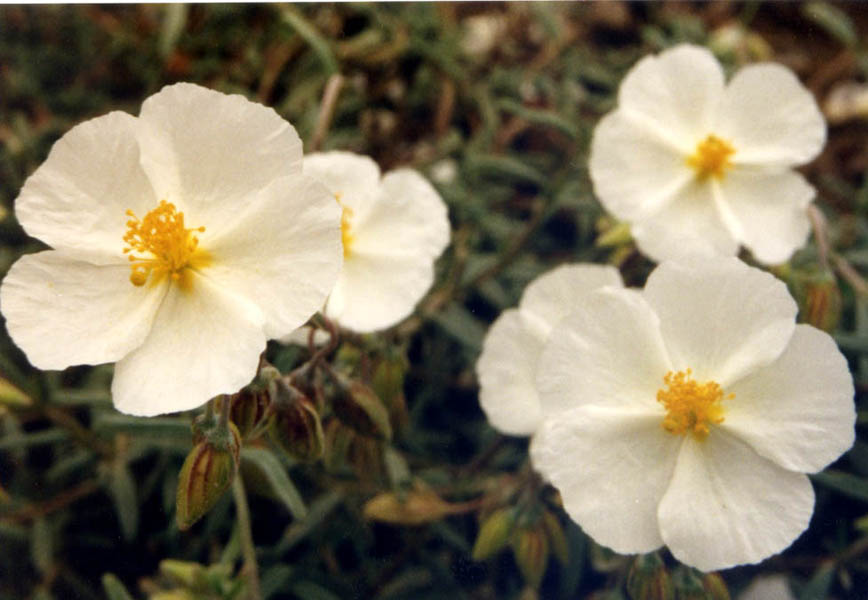
Sub-shrub of the Cistaceae family, present in the Mediterranean basin and a large part of Western Europe, from the Atlantic coasts to the Apennines and the Balkans. It colonizes dry grasslands, open garrigues, calcareous slopes, and sunny rockeries at low and medium altitudes, always on well-drained and often calcareous substrates.
It forms spreading bushy clumps, 20 to 40 cm in height, with woody stems at the base and erect flowering branches. The leaves, narrowly lanceolate, are dark green on the upper side and distinctly whitish and tomentose underneath, giving the plant a characteristic bicolored appearance when not in bloom. The flower buds, covered with a grayish down, add to this overall silvery impression.
The flowers are large for the genus, with five pure white slightly crumpled petals, centered on a very abundant cluster of golden yellow stamens. Each flower is ephemeral, lasting only one day, but their succession is continuous and abundant. The third photo shows a spontaneous or cultivated association with a helianthemum with pink flowers, which highlights the purity of the white of the appeninum.
In its natural habitat, its flowering extends from April to June. In cultivation, it can begin as early as March-April.
It requires poor, very well-drained soil, preferably calcareous, in full sun, and perfectly withstands summer drought. A light pruning after flowering maintains the compactness of the habit. Hardy down to about -15°C in dry soil.