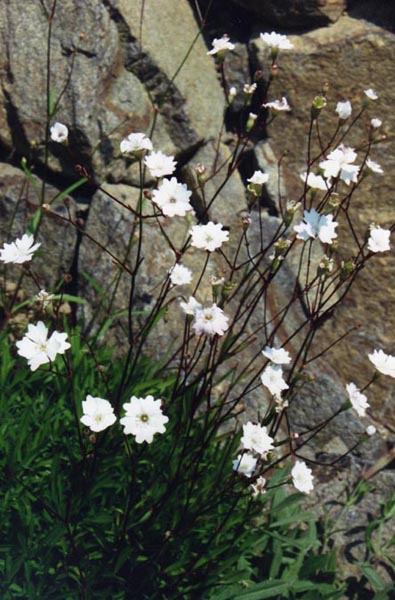
(Silene alpestris)
(Silene alpestris)
Perennial of the Caryophyllaceae family, Heliosperma alpestre is a species of the mountains of Central and Southern Europe, found in the Alps, the Apennines, the Carpathians, and the Balkans. It colonizes damp and shaded rocks, seeping walls, and cliff crevices, generally between 800 and 2,200 meters in altitude, both on limestone and silica.
It forms a dense and compact tuft of linear, narrow leaves, bright green and slightly sticky to the touch. From this base rise slender stems, remarkably dark, almost blackish to brown-purple, branching into very airy cymes reaching 20 to 30 cm in height.
The flowers, pure white, have five deeply bifid petals giving them a finely cut, almost starry appearance. Carried in large numbers at the top of the fine branches, they create a white cloud of remarkable lightness, which the dark stems highlight sharply.
In its natural habitat, it blooms from June to August. In cultivation, it blooms from May to June depending on exposure.
It requires well-drained soil, fresh without excess stagnant moisture, poor to moderately rich, in shade or partial shade. It integrates perfectly into cool rock gardens, walls, and alpine gardens.