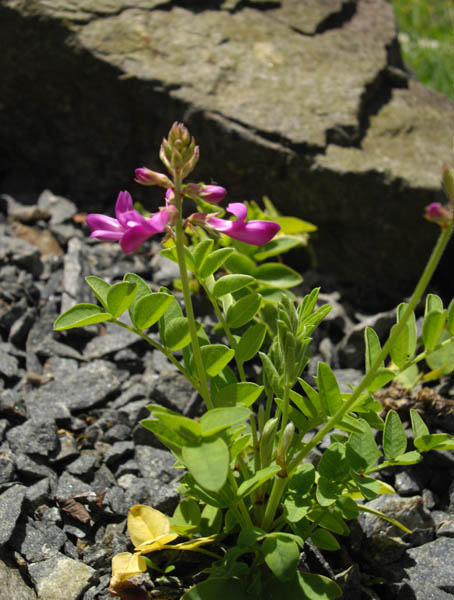
Perennial of the Fabaceae family, found in the mountains of central and southern Europe, from the Alps to the Carpathians and the Balkans, where it occupies rocky grasslands, stabilized calcareous screes, and high-altitude meadows between 1,500 and 2,500 meters.
It forms upright and branched clumps 20 to 40 cm in height. The leaves are imparipinnate, composed of oval leaflets of medium green, slightly glaucous, giving the plant an airy and elegant habit characteristic of alpine legumes.
The flowers, from pink-purple to warm violet, are grouped in elongated and upright clusters, well-supplied, with a classic papilionaceous structure. The keel is distinctly prominent. After flowering, the fruits appear as small jointed pods, slightly winged on the edges, a distinctive feature of the Hedysarum genus.
In its natural habitat, its flowering extends from June to August depending on altitude. In cultivation, it blooms from May to July.
It requires well-drained soil, preferably calcareous, a sunny exposure, and tolerates winter cold well. Adapted to alpine rock gardens, it is not demanding once established but does not tolerate heavy and wet soils in winter.