Shrubby perennial of the Plantaginaceae family, native to New Zealand, where it grows in rocky areas and exposed slopes of the South Islands, at altitudes that can exceed 1,000 meters.
In its natural habitat, it colonizes rocky outcrops, stabilized scree, and wind-swept high-altitude meadows, in conditions of perfect drainage and intense sunlight. It behaves as a low, sprawling ground-cover shrub, forming dense mats barely exceeding 20 to 30 cm in height with a spread that can reach 60 to 90 cm.
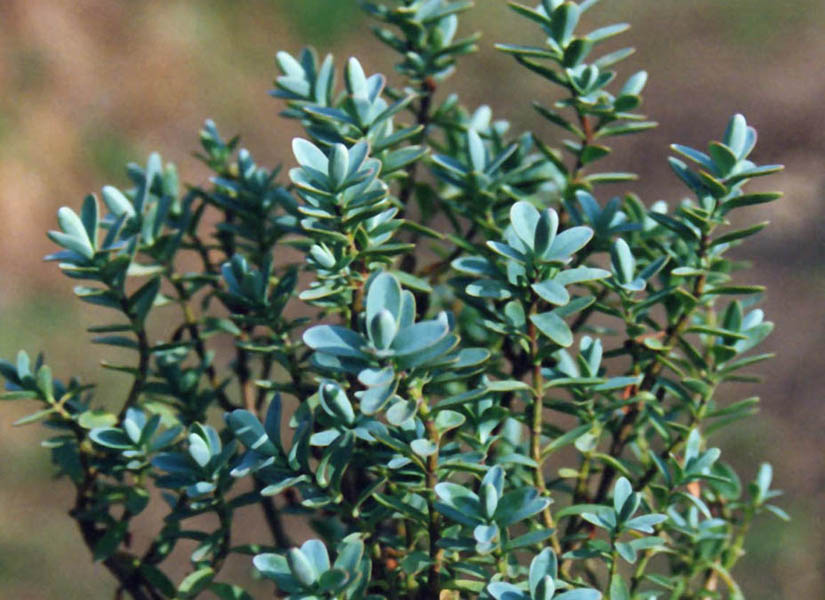
The foliage is one of the most distinctive features of the species: the leaves, small, fleshy, gray-blue to glaucous, are tightly packed along woody stems arranged in a fan shape, giving the plant a very particular dense and geometric appearance. The flowers, pure white, are grouped in small, upright axillary spikes, standing out sharply against the silvery background of the foliage.
In its natural habitat, its flowering extends from November to January in the southern hemisphere. In cultivation under our latitudes, it blooms from May to June.
It requires full sun exposure, well-drained, slightly poor soil, and tolerates limestone well. Hardy down to about -10 °C in dry soil, it is especially wary of stagnant winter humidity. Excellent for rock gardens, walls, and terrace containers.