Haplopappus macrocephalus
Perennial of the Asteraceae family, native to the Andes of Chile and Argentina, where it colonizes screes, rocky areas, and exposed high-altitude grasslands, generally between 1,500 and 3,000 meters.
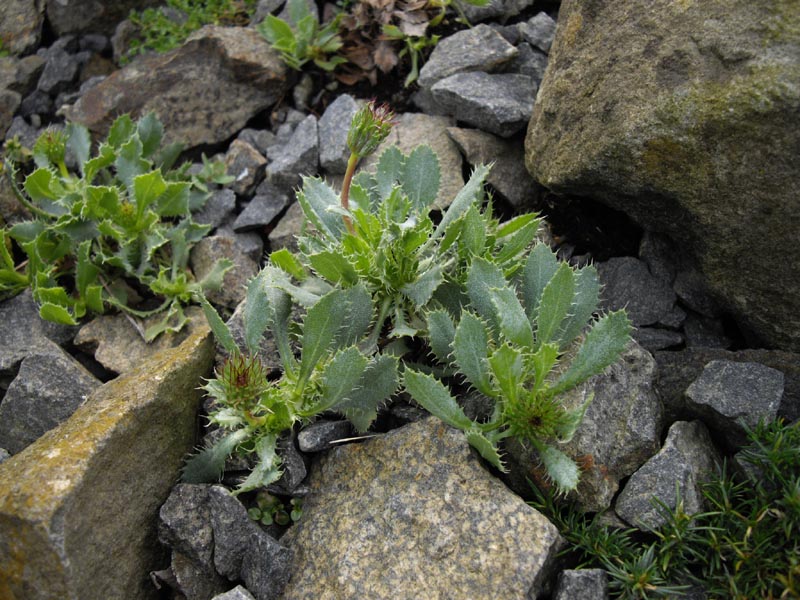
It forms a low and compact rosette, very close to the ground, barely reaching 5 to 10 cm in height when in bloom. The leaves are oblong to lanceolate, with distinctly toothed margins armed with rigid spinulous teeth, medium green slightly grayish, with a hispid surface to the touch. Arranged in a spread and rather loose rosette, they give the plant a robust and defensive appearance, well adapted to the windy screes of the high Andes. This leathery and spiny foliage forms a striking contrast with the luminous warmth of the capitula that rise from it.
The capitulum, solitary and borne on a very short peduncle, is remarkably large compared to the size of the plant — as highlighted by the epithet macrocephalus. The bracts of the involucre are edged with bright red, heralding a capitulum open to intense orange to red-orange ligules, around a yellow-orange disc marked with red. The variation in hue between individuals is notable, ranging from bright yellow to burnt orange, or even deep red.
In its natural habitat, flowering extends from December to February. In cultivation under our latitudes, it occurs from May to July.
It requires perfect drainage, a lean and mineral soil, and full sun exposure. It is advantageously cultivated in a container or elevated rockery, sheltered from prolonged winter humidity.