Perennial of the Asteraceae family, native to Chile and Argentina, where it grows in rocky areas and dry high-altitude grasslands of the Andes, generally between 1,000 and 2,500 meters.
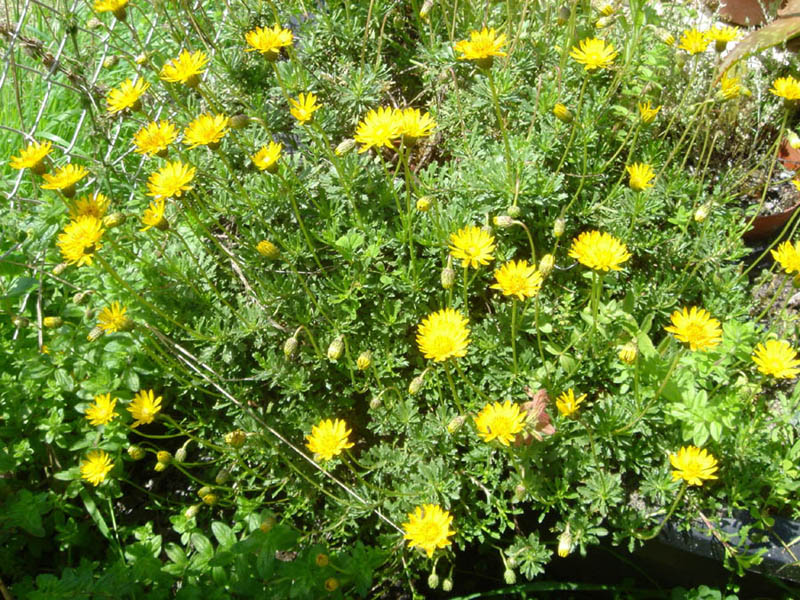
It forms a dense and spreading cushion, low and bushy, reaching 15 to 25 cm in height with a spread often exceeding 30 cm. The leaves are small, deeply cut to pinnatifid, bright green, slightly sticky to the touch — a characteristic recalled by the epithet glutinosus — and emit a slight resinous scent when crushed.
The capitula are solitary, borne by slender erect peduncles above the foliage, and of a bright and luminous yellow, with well-developed ligules around a central disc of the same hue. The generosity of the flowering is striking: the plant can be covered with dozens of capitula simultaneously, almost entirely masking the foliage.
In its natural habitat, flowering extends from November to January, aligned with the austral summer. In cultivation under our latitudes, it blooms from May to July, sometimes with a resurgence in autumn.
It requires very well-drained, poor soil, in full sun exposure. Hardy to about -10°C in dry soil, it especially dreads stagnant winter moisture.