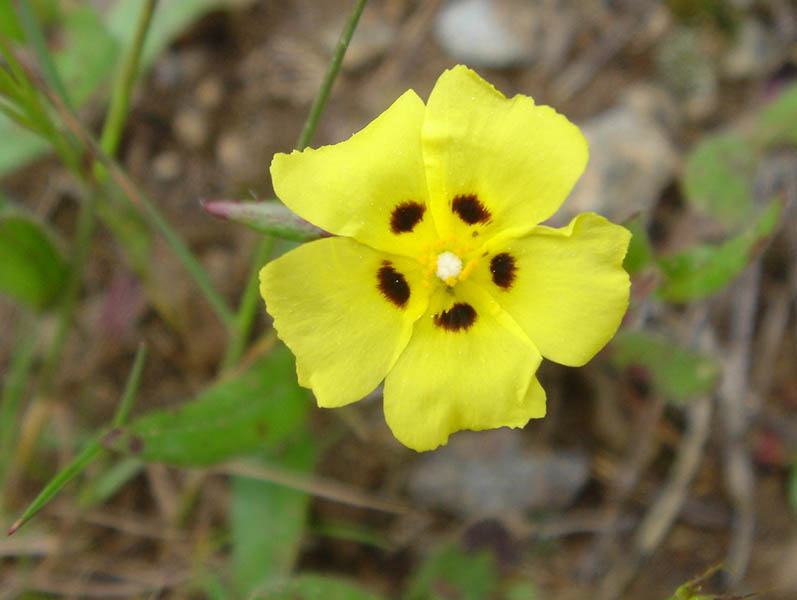
- photographed in Spain -
- photographed in Spain -
Sub-shrub of the Cistaceae family, widespread in the western Mediterranean region, from the Iberian Peninsula to Morocco and Algeria, with a few locations in Mediterranean France. It occupies coastal dunes, open garrigues, dry heaths, and sandy or gravelly wastelands, always in full light and on well-drained substrate, generally at low altitude.
It forms a bushy shrub 50 cm to 1 meter in height, with whitish branches covered with a dense, star-shaped indumentum that gives the entire foliage a characteristic grayish to whitish appearance. The leaves are oval to lanceolate, sessile or nearly so, covered on both sides with the same silvery felt.
The five-petaled flowers are sulfur-yellow to bright yellow, with a well-defined dark brown spot at the base of each petal, forming a dark ring in the center of the flower, an immediate distinctive sign of the species. In its natural habitat, it blooms from April to June.
In cultivation, it requires full sun, poor, sandy or stony soil, perfectly drained, and a warm and sheltered exposure. Its hardiness is limited, around -7 to -8°C in dry conditions; it is suitable for Mediterranean gardens and rockeries in mild climates.