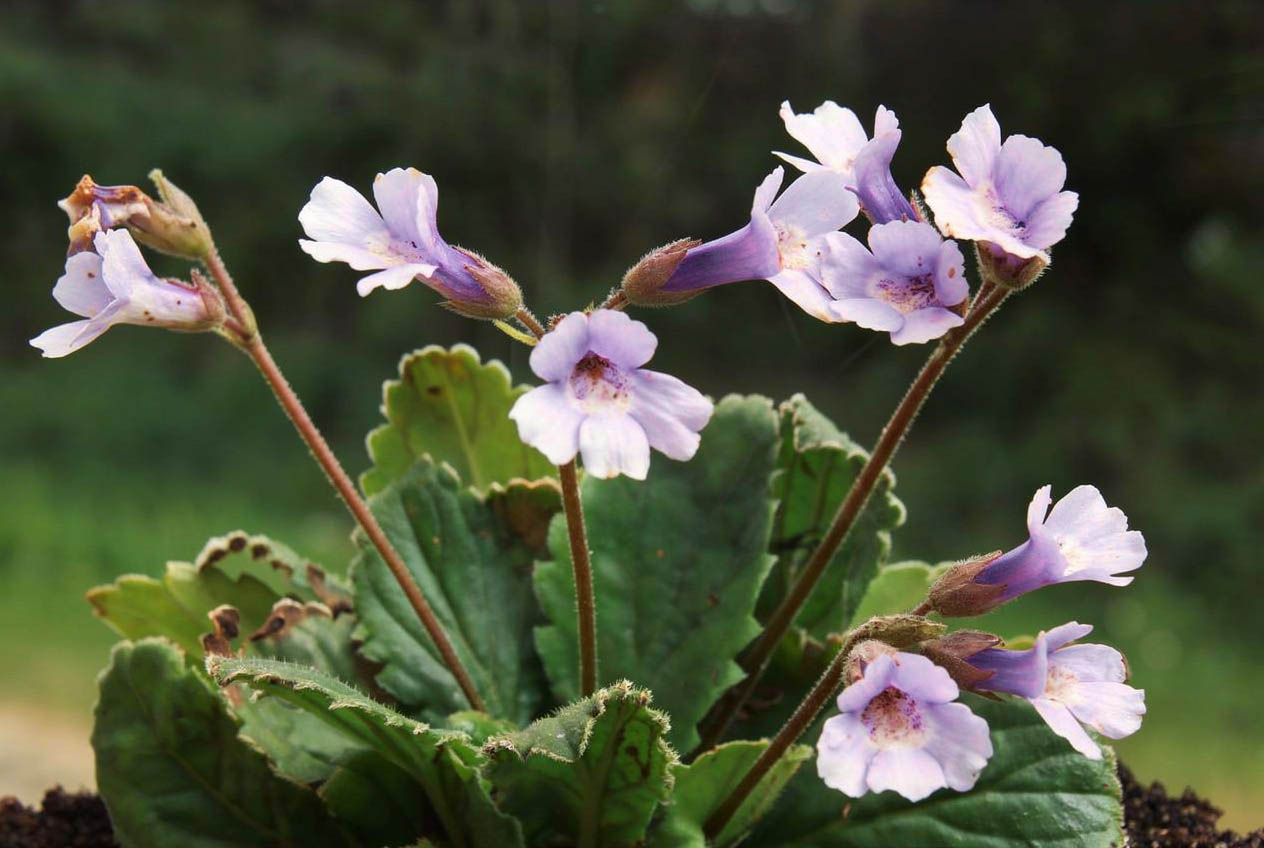
Perennial of the Gesneriaceae family, endemic to the Balkans, mainly the Rhodope Mountains in Bulgaria and northern Greece, where it colonizes shaded rocky walls, cracks in limestone or siliceous cliffs, and moist overhangs, between 500 and 1,800 meters altitude.
It forms flat and spreading, persistent rosettes, 10 to 20 cm in diameter, with no apparent stem. The leaves are oval to obovate, crenate, thick and fleshy, with a shiny dark green upper surface, covered with short hairs that give them a slightly velvety texture to the touch.
The flowers, borne on stems 10 to 15 cm tall, are tubular and slightly bilabiate, from lilac to pale violet with a whitish throat finely spotted. They resemble small streptocarpus flowers, which is not surprising given the botanical relationship. In its natural habitat, its flowering extends from April to June; in cultivation, it generally occurs in April-May.
Haberlea rhodopensis has a remarkable resistance to desiccation: its leaves can almost completely dehydrate and return to their normal appearance after rehydration, a rare property among vascular plants that botanists refer to as a resurrection plant.
In cultivation, it requires a shaded to semi-shaded exposure, a well-drained but fresh substrate, slightly acidic to neutral. It is ideally grown in a shaded wall crevice, trough, or pot, sheltered from stagnant winter moisture.