Perennial of the Caryophyllaceae family, native to the Caucasus and adjacent mountainous regions, where it occupies rock gardens, rocky slopes, and dry alpine lawns.
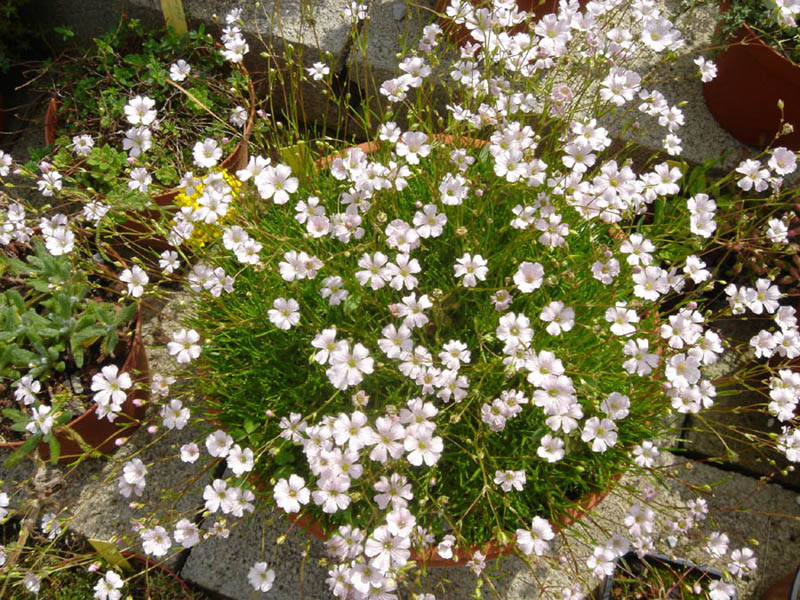
It forms a dense, well-defined hemispherical cushion, 10 to 20 cm in height, from which numerous slender, upright flowering stems rise. The foliage consists of very narrow, almost filiform leaves, of a bright green, giving the tuft a light and finely cut texture, reminiscent from afar of a small tuft of grass.
The flowers, borne individually at the top of slender, branched stems, have five petals, white-pink to pale pink, of great delicacy. Their airy arrangement above the cushion creates an effect of a suspended cloud, very different from the dense carpet of Gypsophila repens. In its natural habitat, its flowering extends from June to August; in cultivation, it generally occurs in May-June.
The combination of a compact cushion and a light and ethereal flowering borne on almost invisible stems constitutes the most distinctive character of this species, which occupies an intermediate place between the mat-forming and tight cushion forms of the genus.
In cultivation, it requires a very well-drained, mineral soil, in full sun. It is suitable for rock gardens, moraines, and cultivation in pots or alpine troughs.