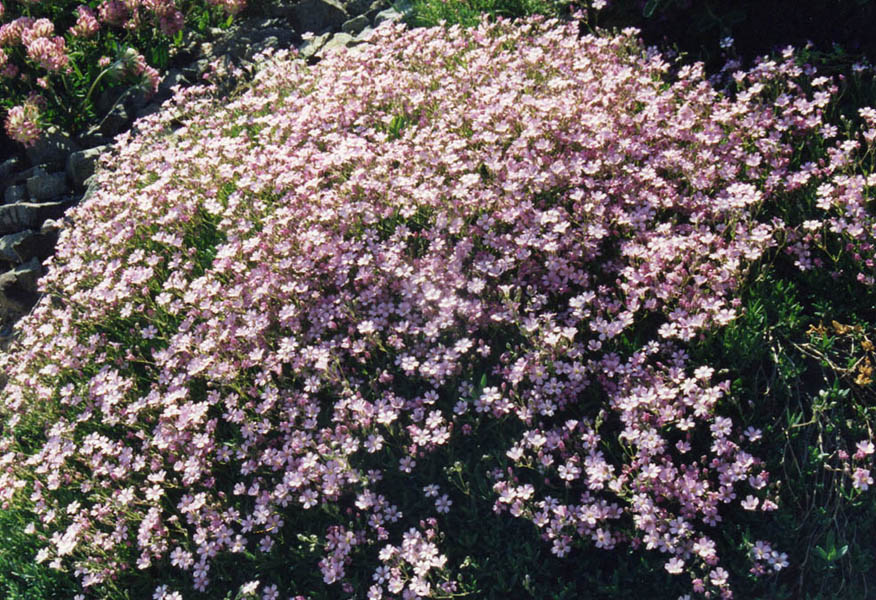
Perennial of the Caryophyllaceae family, native to the mountainous massifs of central and southern Europe, from the Pyrenees to the Carpathians via the Alps and the Apennines, where it grows on limestone scree, rocky areas, and gravelly slopes between 1,000 and 2,500 meters in altitude.
It forms dense and spreading mats, with creeping and branched stems, 10 to 20 cm in height with a spread that can exceed 60 cm. The leaves are linear to lanceolate, glaucous, bluish-gray green, arranged in pairs along the stems.
The flowers, small, with five petals, range from pure white to lilac pink depending on the individuals and cultivated forms; they are borne by light and very branched cymes that form a vaporous cloud above the foliage. In its natural habitat, its flowering extends from June to August; in cultivation, it generally occurs from May to July, with sometimes a slight resurgence.
The ability of this plant to overflow onto rocks and cascade down walls in pink or white cascades is one of its most appreciated qualities in rock gardening. It is also the origin of many cultivars selected for the intensity of their color.
In cultivation, it thrives in full sun in any well-drained soil, preferably limestone. It tolerates drought and is perfectly suited to walls, rocky slopes, and borders of large rock gardens.