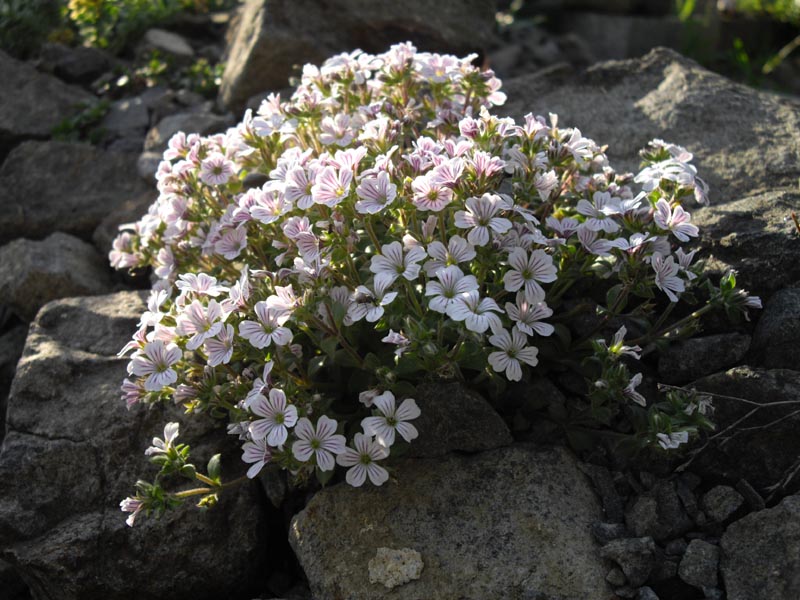
Perennial of the Caryophyllaceae family, native to the Himalayan foothills, from Pakistan to Nepal, where it colonizes rocky screes, gravelly slopes, and rock crevices between 2,500 and 4,500 meters in altitude.
It forms low and spreading, semi-matting clumps, 10 to 15 cm in height with a spread that can exceed 30 cm. The leaves are small, oval to spatulate, medium green, slightly pubescent, arranged in loose rosettes at the base of branched flowering stems.
The flowers, with five rounded petals pure white to pinkish white, are traversed by fine pink to wine-red veins radiating from the center, giving them a very characteristic veined appearance. They are gathered in loose and generous cymes that completely cover the foliage at the time of full bloom. In its natural habitat, its flowering extends from May to July depending on the altitude; in cultivation, it generally occurs from May to June, with sometimes a resurgence in autumn.
This detail of colored veins on a white background is one of the most elegant features of the species, visible under a magnifying glass as well as to the naked eye when the low light illuminates the flowers.
In cultivation, it requires well-drained, slightly sandy soil, in full sun. It tolerates summer drought and adapts equally well to classic rock gardens and dry stone walls.