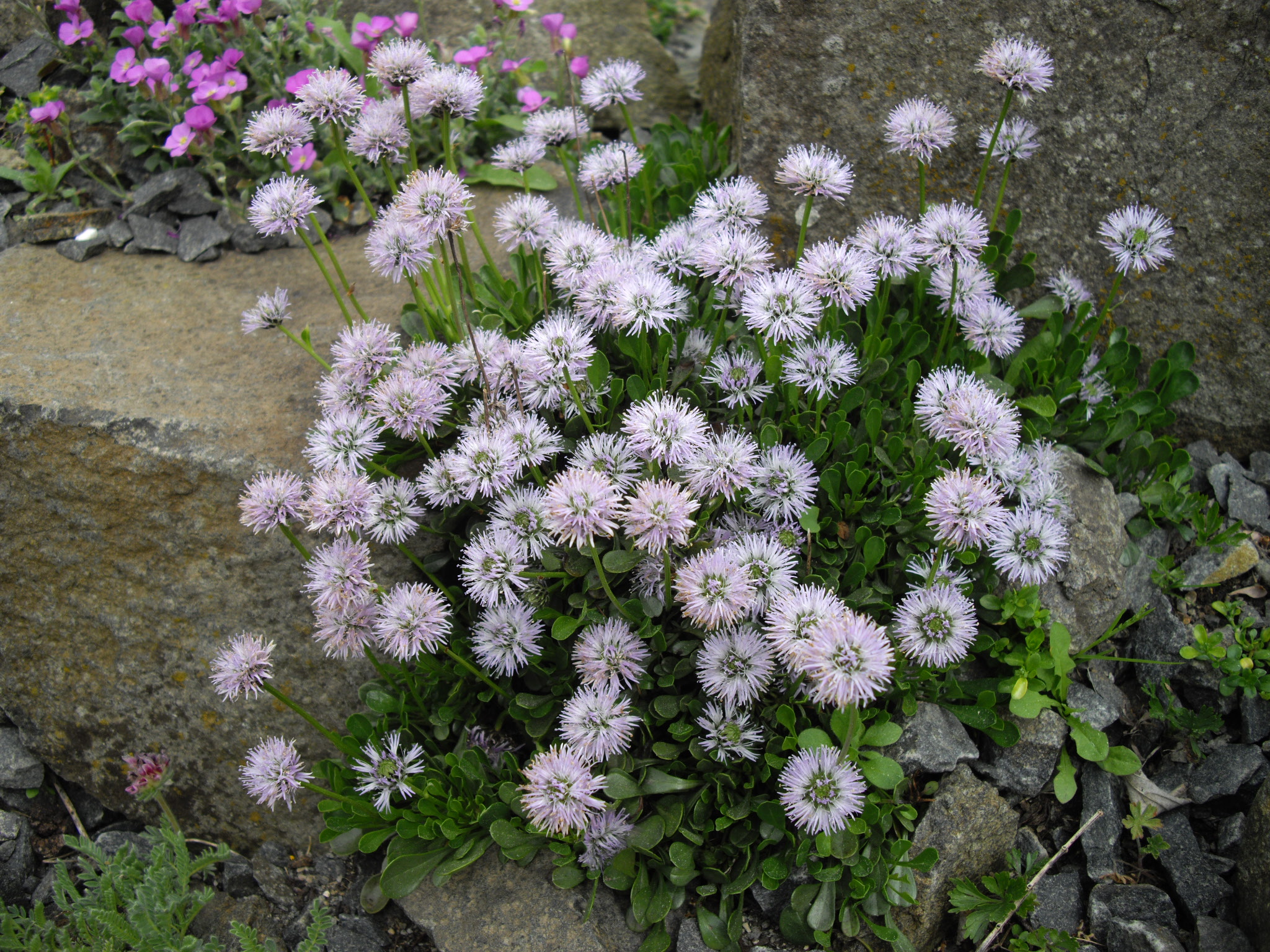
Perennial of the Plantaginaceae family, this globularia is native to the Balkans and western Turkey, where it grows in rocky grasslands, scree, and cracks in calcareous or schist rocks, in sunny exposure, generally between 500 and 1,800 meters in altitude.
It forms low and spreading clumps, 10 to 20 cm in height when in bloom, consisting of numerous rosettes connected by creeping woody stolons. The leaves are small, spatulate to oval, entire, medium green during active growth, but taking on a remarkable dark purple to almost slate hue in winter, with a slight frosted appearance — a particularly striking winter character that few species of the genus share to this degree.
The spherical capitula, borne on slender thin stems, are a very pale lavender blue, almost pinkish lilac, with protruding stamens that give them a finely hairy appearance, true to the etymology of trichosantha — with hairy flowers. In its natural habitat, its flowering extends from May to July. In cultivation, it generally occurs in May-June and can be prolonged by a few late capitula.
It requires well-drained soil, poor to moderately fertile, in full sun, and tolerates indifferently calcareous or slightly acidic substrates. Hardy and generous, it is perfectly suited to rock gardens, walls, and alpine troughs.