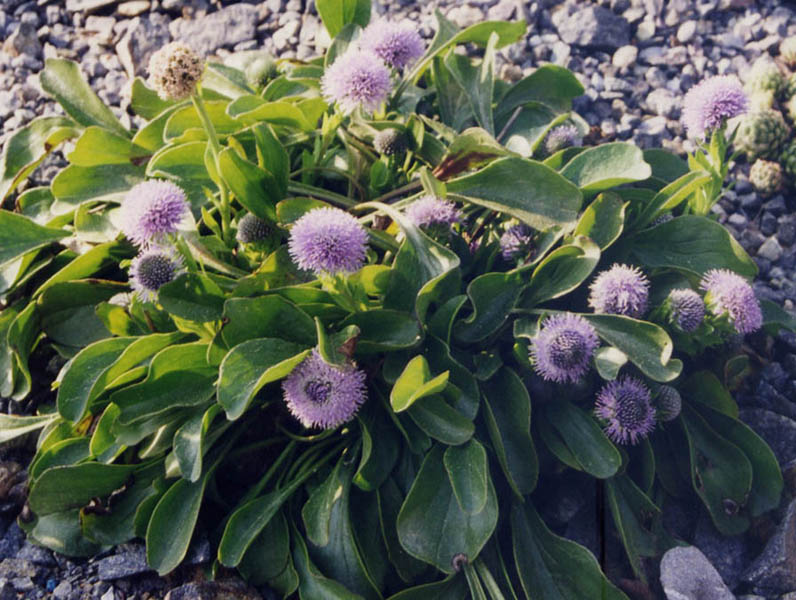
A perennial of the Plantaginaceae family, this globularia is widespread in central and southern Europe, from the Pyrenees to the Balkans, where it occupies dry calcareous grasslands, edges of light woods, stony slopes, and sunny rockeries, from the plains up to about 1,800 meters altitude.
It forms a dense basal rosette of oval to spatulate leaves, entire or slightly notched at the top, leathery, medium to dark green and shiny. The leafy flower stems rise to 15 to 40 cm and bear smaller sessile cauline leaves. A useful distinguishing feature: the basal leaves often have a small notch or tooth at their apex, a detail that may have contributed to nomenclatural confusion with neighboring species.
The spherical capitula are a fairly deep blue-violet, noticeably more saturated than in G. nudicaulis, with a darker center clearly visible at full bloom. In its natural habitat, its flowering extends from April to June. In cultivation, it generally blooms in May.
It thrives in well-drained calcareous soil, poor to moderately fertile, in full sun. Frugal and hardy, it is suitable for rockeries, dry slopes, and gravel gardens, where it reseeds modestly without becoming invasive.