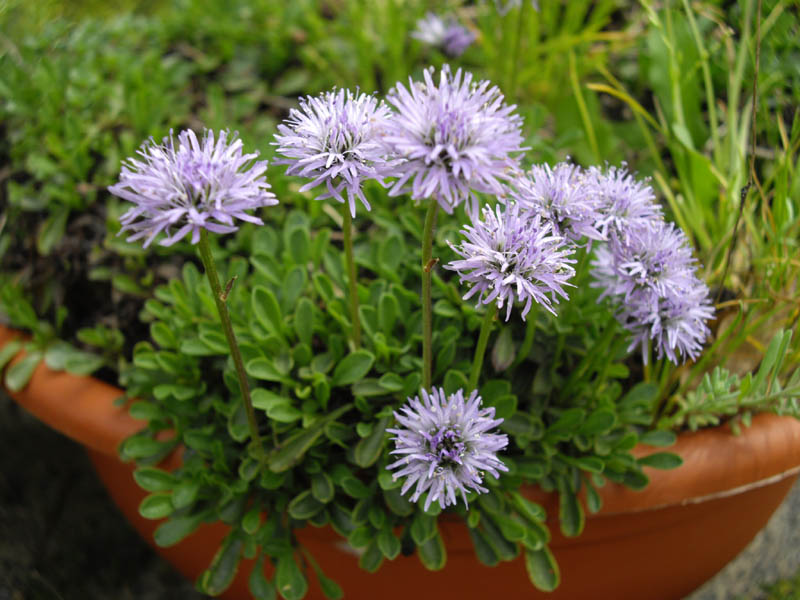
A subshrub perennial of the Plantaginaceae family, this globularia is native to the mountains of southern Europe, from the Maritime Alps to the Apennines and the Balkans, where it grows in rocky grasslands, rock crevices, and sunny limestone screes, at altitudes of approximately 800 to 2,200 meters.
It forms a dense and compact cushion, woody at the base, 5 to 15 cm in height, covered with small spatulate to obovate leaves, leathery, dark green and shiny, evergreen. From this cushion rise short erect stems each bearing a solitary spherical capitulum of lavender blue to medium violet, with bilabiate tubular flowers whose protruding stamens give the whole a finely bristled appearance very characteristic of the genus.
In its natural habitat, its flowering extends from June to August depending on the altitude. In cultivation, it generally blooms in May-June.
Its persistent, compact, and ornamental cushion-like habit even when not in bloom makes it a sought-after plant for rock gardens and alpine troughs. It requires a limestone soil, very well-drained, full sun exposure, and is wary of excess winter moisture. Hardy and undemanding once established, it tolerates summer drought and cold well.