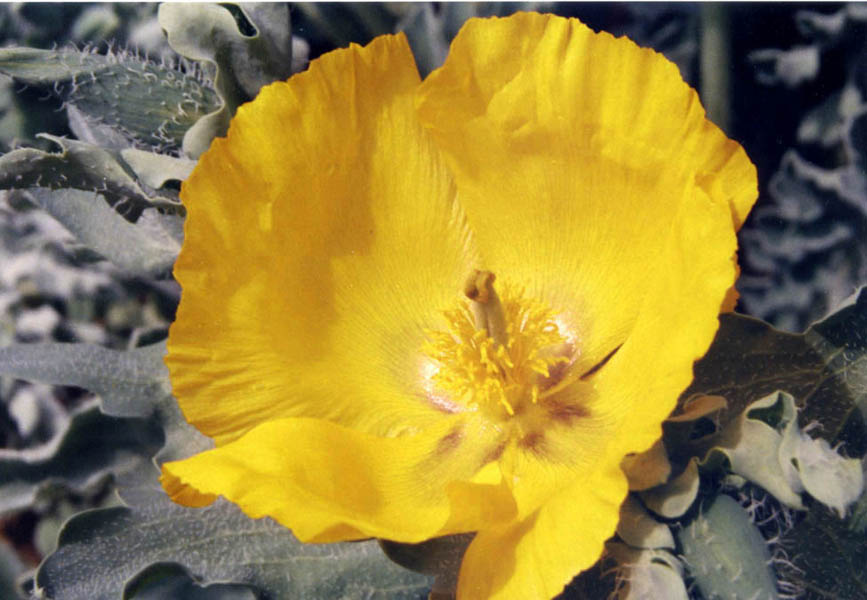
Perennial or biennial from the Papaveraceae family, Glaucium flavum, or yellow horned poppy, is native to the European and Mediterranean coasts, from the British Isles to the Black Sea and Asia Minor. It colonizes pebble beaches, coastal dunes, sea cliffs, and sandy or stony wastelands, always in full light and well-drained conditions.
It forms a sprawling basal rosette, very ornamental, with large deeply lobed leaves, a characteristic glaucous bluish-green and pruinose, with a crinkled and slightly fleshy surface. The upright flowering stems reach 30 to 80 cm, branched, bearing solitary flowers with four widely open petals, bright yellow to orange-yellow, crumpled like tissue paper at blooming.
In its natural habitat, its flowering extends from June to September. In cultivation, it occurs from May to August depending on exposure.
Its fruit is spectacular: a long narrow and arched silique that can exceed 30 cm, which persists after flowering and constitutes a distinctive decorative element on its own. The plant contains a toxic orange-yellow latex, formerly used in folk medicine. It is cultivated in full sun, in perfectly drained, poor, and stony soil; it tolerates drought and wind but dreads stagnant moisture in winter.