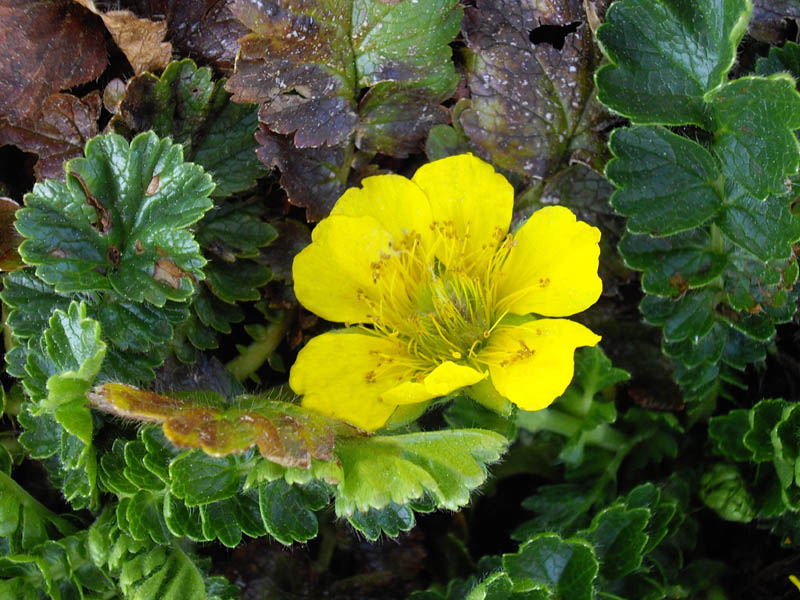
A perennial of the Rosaceae family, Geum reptans is a species of the high mountains of Europe, found in the Alps, the Carpathians, and the eastern Pyrenees. It colonizes mobile screes, glacial moraines, and pioneering high-altitude areas, generally between 2,000 and 3,500 meters, on siliceous and well-drained substrates. It is among the hardiest plants of the alpine and nival zones.
Its habit is creeping and stoloniferous: it emits long reddish stolons that spread over the ground and form new rosettes at a distance, an effective strategy for colonizing unstable and poor substrates. The leaves are pinnate, with many crenellated leaflets, bright green, slightly hairy.
The flowers, borne individually on short erect stems, are widely open, with rounded petals of a bright sulfur yellow, slightly paler than those of Geum montanum, with a center of abundant stamens. After flowering, the fruiting produces feathery heads comparable to those of the neighboring species.
In its natural habitat, its flowering extends from July to September depending on the altitude.
In cultivation, it requires a very well-drained, poor soil, in full sun, with good spring moisture. Delicate to maintain in the lowlands, it is more suited to an alpine trough or a cold and airy rock garden.