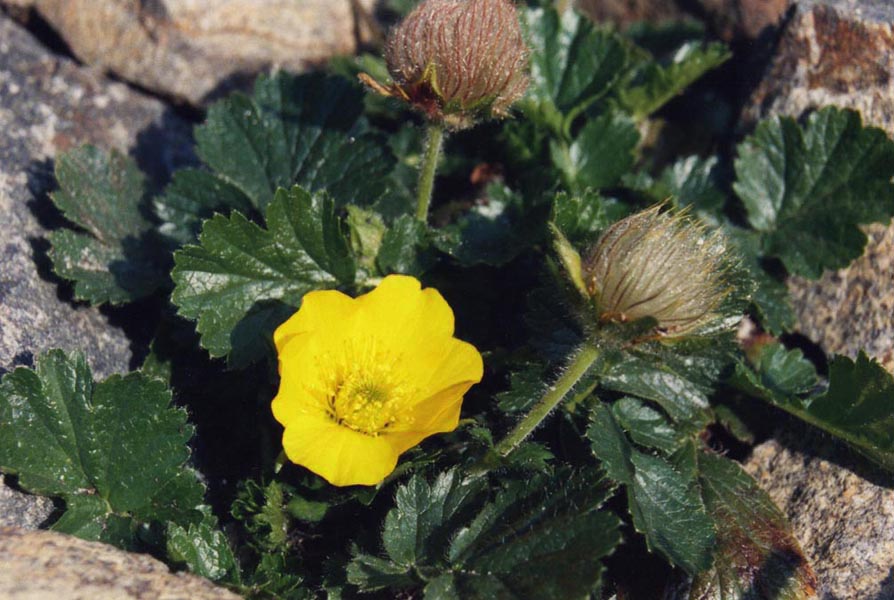
A perennial of the Rosaceae family, Geum montanum is a species from the mountains of Central and Southern Europe, found in the Alps, the Pyrenees, the Carpathians, and the Apennines. It inhabits alpine meadows, grassy screes, rocky ridges, and bilberry heaths, generally between 1,500 and 2,800 meters in altitude, on acidic to neutral substrates.
It forms a low and compact basal rosette, reaching 5 to 15 cm in bloom. The leaves are pinnate, with a very developed, rounded, and crenate terminal lobe, dark green and slightly blistered, covered with fine hair that gives them a velvety feel to the touch.
The flowers, borne individually on erect and hairy stems, are widely open, with bright and vivid yellow rounded petals, with a center of yellow-green carpels and stamens. The flower buds, globular and densely bristled with reddish hairs, are particularly characteristic.
After flowering, the plant develops a spectacular fruiting head: a dense sphere of elongated styles, reddish at maturity and feathery, which spread out star-like and beautifully capture the low-angled light.
In its natural habitat, its flowering extends from June to August depending on altitude. In cultivation, it blooms from May in the lowlands.
It requires well-drained, acidic to neutral soil, in full sun, and withstands winter cold well. It is perfectly suited to rock gardens and alpine gardens.