A perennial from the Rosaceae family, Geum coccineum is native to the Balkans and Turkey, where it grows in mountain meadows, grassy screes, and rocky slopes, generally between 1,000 and 2,500 meters in altitude. The 'Borisii' cultivar was selected in Bulgaria and dedicated to Tsar Boris III.
It forms a compact and well-stocked basal clump, reaching 25 to 35 cm in height when in bloom, shorter and more compact than the hybrids of G. chiloense. The leaves are pinnate, with a rounded and crenate terminal lobe, bright green, slightly hairy, persisting in a low rosette on the ground during winter.
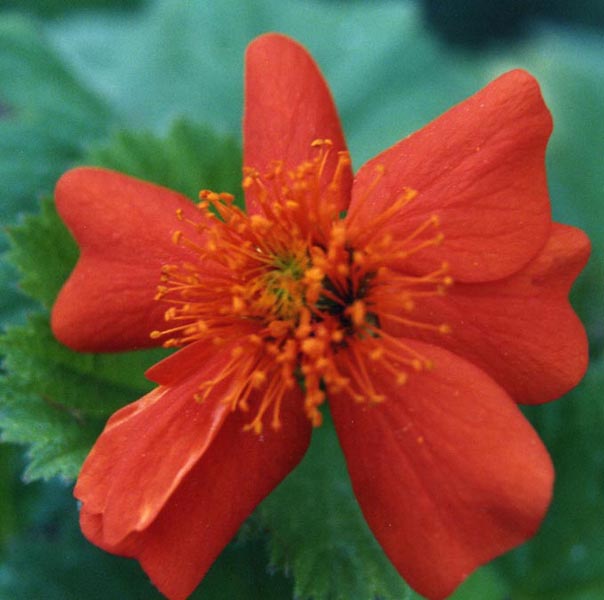
The flowers, borne on slender and branched stems, have widely spread and slightly overlapping petals, of a bright and warm orange-red. The heart is particularly remarkable: a dense tuft of stamens with bright orange filaments and golden yellow anthers forms a luminous pompom that contrasts and enriches the hue of the petals.
In its natural habitat, its flowering extends from May to July. In cultivation, it often begins as early as April and can continue until June, with sometimes a slight resurgence in autumn.
It appreciates well-drained soil, not too rich, in full sun, and tolerates relatively dry conditions in summer, making it well-suited to rock gardens and gravel gardens.