Perennial of the Geraniaceae family, Geranium versicolor is native to southern Italy, the Balkans, and Greece, where it colonizes clear undergrowth, shaded forest edges, and grassy slopes, from sea level up to about 1,500 meters altitude.
The plant forms loose and spreading clumps, reaching 30 to 50 cm in height, with a flexible and slightly drooping habit. The foliage is evergreen to semi-evergreen depending on the climate, composed of palmately lobed leaves with five well-marked lobes, of medium green, sometimes marked with lighter spots at the center of the divisions.
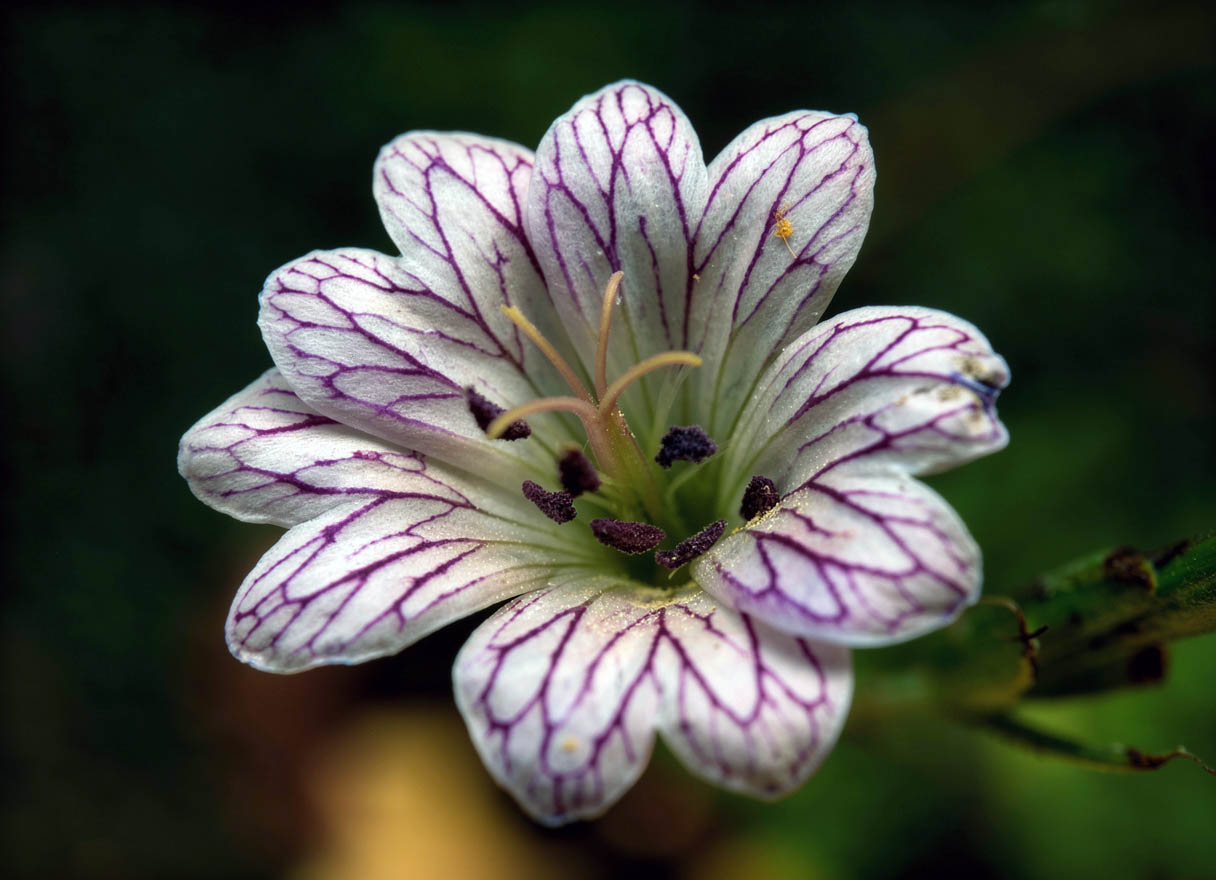
The flowers are small, barely exceeding 1.5 cm in diameter, borne solitary on thin peduncles. Their five white to pale pink petals are traversed by a dense network of finely branched purple-violet veins, giving them a distinctly veined appearance. The dark, almost black anthers enhance the contrast at the heart of the flower.
In its natural environment, its flowering extends from May to July. In cultivation, it can continue intermittently until autumn, especially if the plant is rejuvenated after the first flowering.
It appreciates fresh, well-drained soil, rich in humus, in light shade or partial shade. Easy to care for, it self-seeds readily and is suitable for woodland gardens or shaded borders with a natural character.