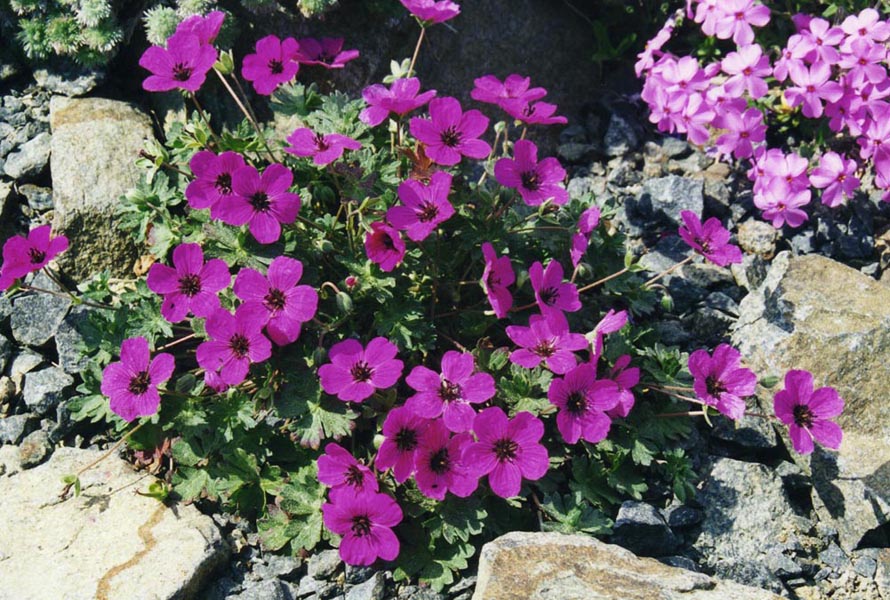
A perennial from the Geraniaceae family, Geranium subcaulescens is native to the Balkans and southern Italy, where it colonizes rockeries, rocky slopes, and alpine meadows, generally between 1,500 and 2,500 meters.
It forms a low, spreading cushion, reaching 10 to 15 cm in height, with thin, creeping, slightly pubescent stems. The leaves, divided into five to seven lobes themselves toothed, are medium green to gray-green, supple and delicately hairy.
The flowers, borne individually on slender peduncles, measure up to 3 cm in diameter. Their petals are an intense magenta to bright purple, traversed by fine dark veins, and marked in the center with a well-contrasted black eye, a very distinctive feature of the species.
In its natural habitat, its flowering extends from June to August. In cultivation, it occurs from May to July, with sometimes a resurgence in autumn.
It is cultivated in full sun, in well-drained soil, poor to moderately rich, calcareous or not. It tolerates summer drought well once established and is perfectly suited to rockeries, walls, and gravel gardens. Note that in commerce, confusion with the cultivar 'Splendens' is common.