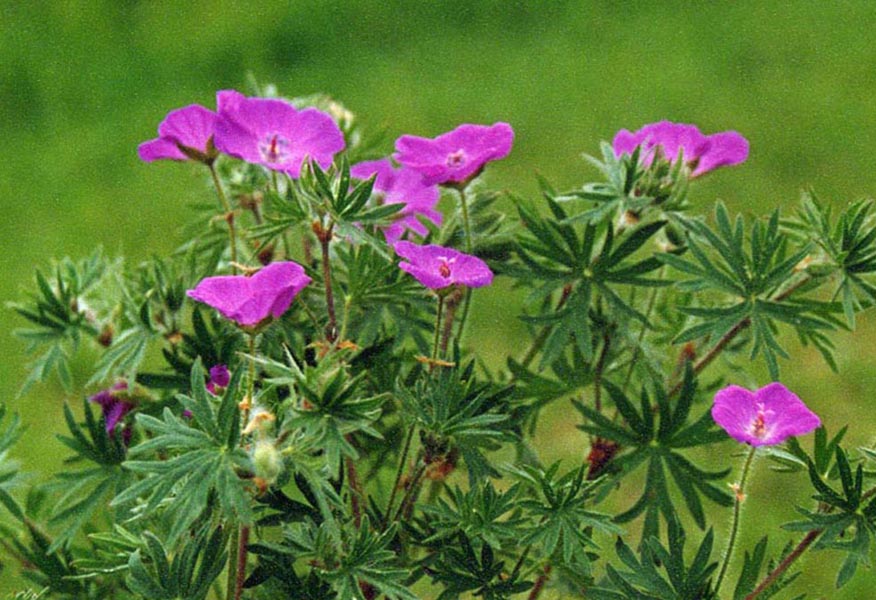
Perennial of the Geraniaceae family, the bloody geranium is widespread in much of temperate Europe and the Caucasus, where it colonizes dry lawns, clear forest edges, rocky areas, and sunny limestone slopes, from the plains to the lower mountain levels.
It forms dense and spreading clumps, 20 to 40 cm in height, with branched and slightly reddish stems. The foliage is deeply cut into five to seven narrow and toothed lobes, a shiny dark green in summer, which takes on particularly vivid orange to scarlet hues in autumn, thus offering a second highly decorative period well after the end of flowering.
The flowers are solitary, borne on long peduncles standing above the foliage, giving them a very recognizable airy presence. They are a bright and luminous magenta to pink-purple, with five broad and rounded petals, traversed by fine darker veins radiating from a whitish to pale pink center. This lighter central area creates a slight halo effect that accentuates the depth of color towards the petal edges. The white stamens and bright pink style form a neat and precise small central bouquet. The flower, viewed from the front, is perfectly round, without the marked notch observed in other species of the genus. Its pure magenta hue, without blue or violet nuances, is one of the most intense of the genus, and contrasts sharply with the finely cut dark green foliage of the clump.
In its natural habitat, its flowering extends from May to August. In cultivation, it often begins in May and can continue until September with a light pruning after the first flush.
Particularly hardy and accommodating, it tolerates poor, dry, and calcareous soils, in full sun. Once established, it requires no care and withstands summer drought well, a valuable quality for exposed rock gardens.