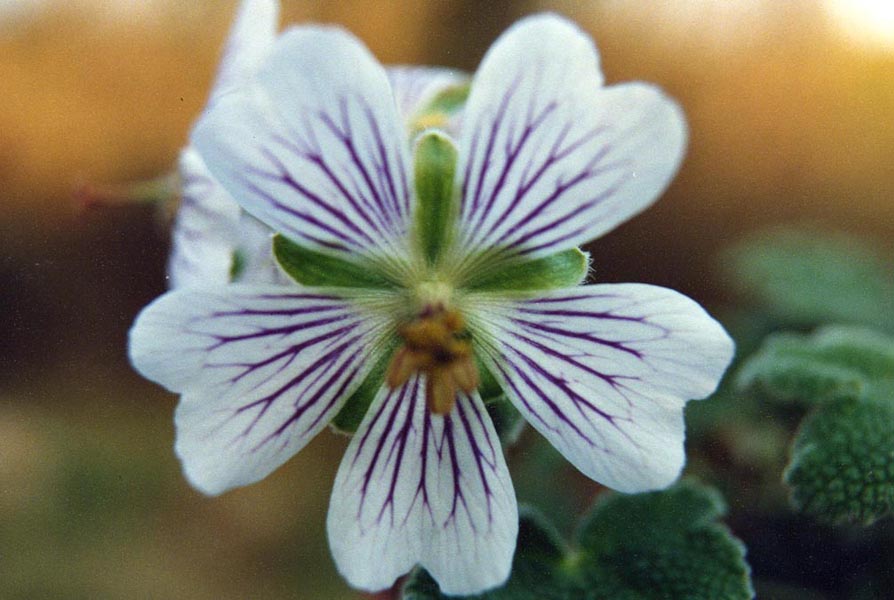
A perennial from the Geraniaceae family, Geranium renardii is native to the Caucasus, where it grows on rocky slopes and high-altitude meadows, in cool and well-drained conditions.
It forms compact and rounded clumps of 20 to 30 cm in height, with a neat and orderly habit. Its foliage is one of the most remarkable of the genus: the leaves are rounded, shallowly lobed, with crenate edges, a grayish-green color, and a strongly blistered texture, almost corrugated, soft and slightly velvety to the touch. This partially evergreen and highly decorative foliage is of interest throughout the season.
The flowers, borne above the foliage on slender stems, are white slightly washed with mauve, with notched petals and traversed by very marked dark violet veins radiating from the center, creating a striking veined effect, particularly visible up close.
In its natural habitat, its flowering extends from June to July. In cultivation, it generally occurs in May-June, with sometimes a slight resurgence.
It requires well-drained soil, rather poor and stony, in full sun. It tolerates summer heat and occasional drought once established. An excellent subject for sunny rock gardens, where its textured foliage remains visible long after the flowering has ended.