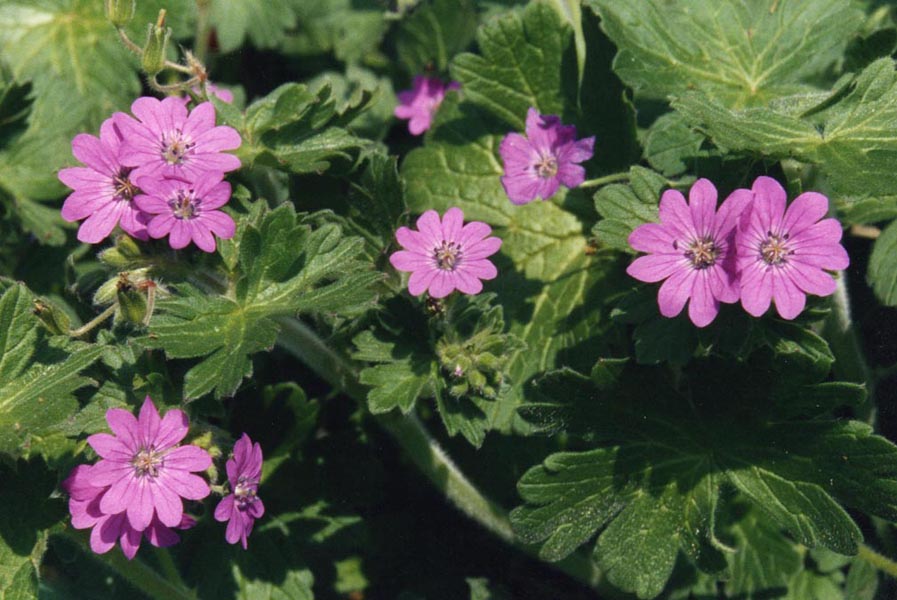
A perennial from the Geraniaceae family, the Pyrenean geranium is native to southwestern Europe, the Pyrenees, and the Mediterranean region, but it has become widely naturalized in much of temperate Europe. It colonizes meadows, grassy banks, roadsides, and edges, from the plains to mountainous areas.
It forms loose and spreading clumps, 20 to 50 cm in height, with branched and pubescent stems. The foliage is rounded and shallowly lobed, with obtuse and crenate lobes, a fairly dense medium green, slightly hairy to the touch; its flexible and bushy appearance is characteristic.
The flowers are small but numerous and generously distributed over the entire plant, ranging from pink-purple to deep magenta pink, with petals distinctly notched at their top, giving them a slightly fringed and very recognizable appearance. The center is marked with fine dark veins.
In its natural habitat, its flowering extends from May to August, making it one of the longest-flowering species of the genus. In cultivation, this generosity is fully confirmed.
Adaptable and hardy, it accepts ordinary soils, even poor or calcareous, in full sun or partial shade. It readily reseeds itself, which can make it locally abundant, but never truly invasive in a rock garden or natural garden context.