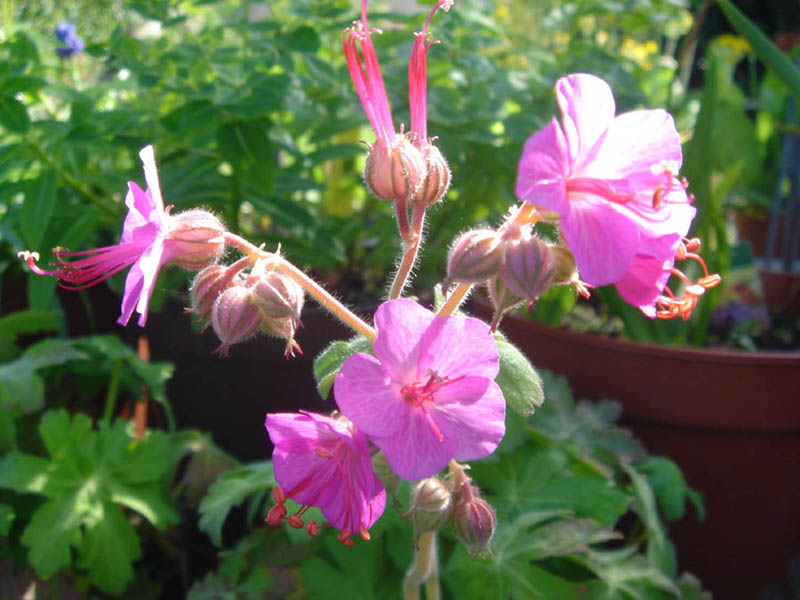
Perennial of the Geraniaceae family, Geranium macrorrhizum is native to the mountainous regions of Southern Europe, from the Alps to the Caucasus, through the Balkans and the Apennines, where it colonizes rocky scree, shaded cliffs, open forests, and old walls, generally between 500 and 2,000 meters.
It forms dense and covering carpets, 30 to 40 cm in height, thanks to its thick and fleshy rhizomes which give it its name — macrorrhizum literally meaning "with large root". These rhizomes creep on the surface and gradually spread, making the plant particularly effective as ground cover.
The foliage, semi-persistent, is broadly palmatilobed, of a bright medium green, and releases a pronounced resinous and camphoraceous odor when crushed, an immediately recognizable characteristic. In autumn, the leaves turn orange-red and crimson. The flowers, pink to pink-magenta, sometimes whitish depending on the individuals, are borne in small terminal clusters above the foliage.
In its natural habitat, its flowering extends from May to July. In cultivation, it occurs from May to June.
Remarkably accommodating, it tolerates drought, dry shade, and poor soils, conditions where few ground-covering perennials can compete with it. A well-drained soil and an exposure from partial shade to shade are perfectly suitable. It is also used in traditional phytotherapy in the Balkans for its astringent properties.