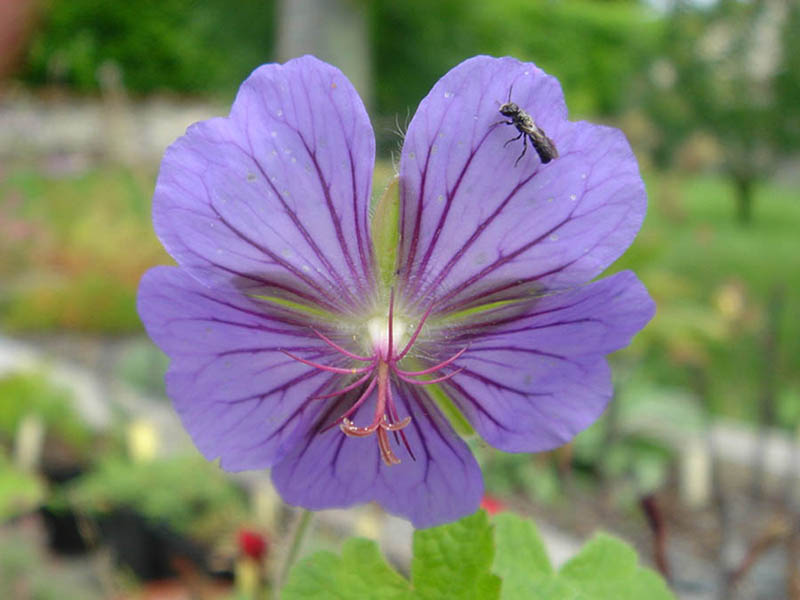
Perennial of the Geraniaceae family, Geranium erianthum is native to the circumboreal regions of the North Pacific, found in Alaska, the Aleutian Islands, Kamchatka, and northern Japan, where it grows in moist subalpine meadows, forest edges, and grassy slopes, generally between 500 and 1,500 meters.
It forms upright and vigorous clumps, 30 to 60 cm in height, with foliage broadly cut into deeply toothed lobes, of medium green, slightly hairy. The habit is rather erect, more structured than bushy.
The flowers are large and very ornamental, of a bright blue-violet to blue-lilac, traversed by well-marked purple veins radiating from a white center. The stamens with pink filaments and the prominently curved styles add an extra delicacy to the flower. The name erianthum precisely refers to the hairs present on the stamens.
In its natural habitat, its flowering extends from June to July. In cultivation, it occurs from May to July depending on the climate.
It requires soil that is fresh to moderately moist, well-drained, rich in humus, in full sun or partial shade. It tolerates cold well and is suitable for large rock gardens, naturalistic beds, and compositions with a Nordic or mountainous character.