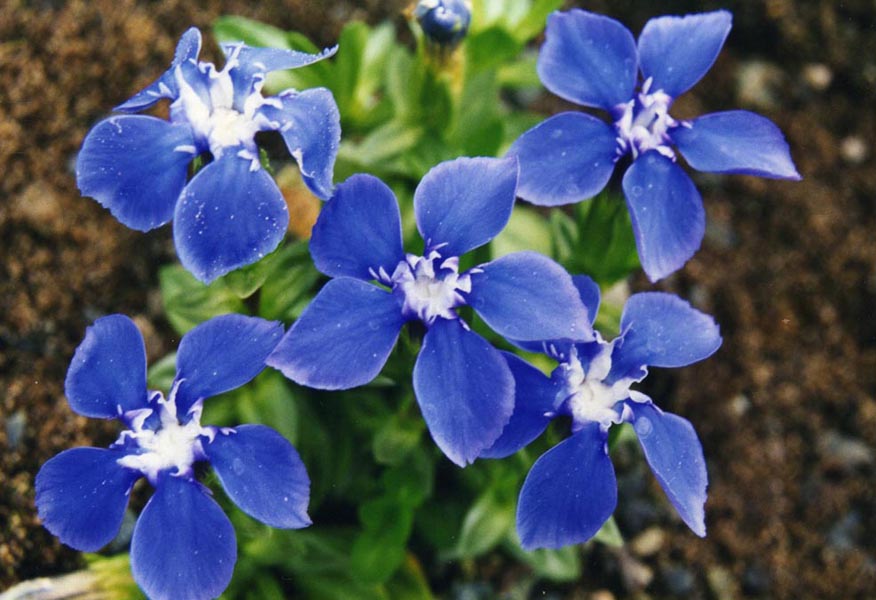
A perennial of the Gentianaceae family, the spring gentian is widespread across the mountains of Europe, from the Atlantic to the Caucasus and Central Asia, with isolated populations in the British Isles and the Apennines. It occupies short limestone grasslands, alpine and subalpine meadows, sunny rocky areas, and sparse pastures, generally between 1,000 and 2,800 meters, more rarely in plains on limestone substrates.
It forms small, very compact basal rosettes, 5 to 10 cm in height when in flower, sometimes creating large dense carpets on grazed grasslands. The leaves are oval-lanceolate, rigid, of a medium green slightly glossy, arranged in a tight rosette.
The flower, solitary and upright on a short stem, is of an azure blue with a purity and intensity rarely equaled in European flora. The corolla opens in a star shape with five well-spread lobes, with white folds between the lobes that add to the clarity of the floral design. The throat is white. It is this absolute cerulean blue, almost unreal in the alpine light, that has made this species one of the most celebrated symbols of mountain flora.
In its natural habitat, its flowering extends from March to June depending on altitude and snow cover. In cultivation, it blooms from April to May.
It requires in cultivation a limestone soil, very well-drained, lean and humus-rich, in full sun; it does not tolerate rich or heavy soils and winter stagnation. Known to be delicate to establish, it rewards patience with a bloom of unparalleled beauty in the rock garden.