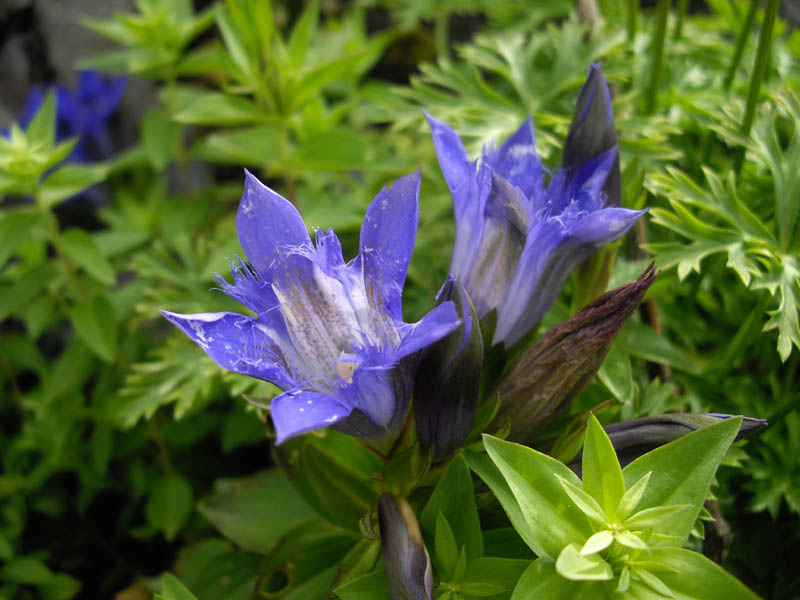
Perennial of the Gentianaceae family, this variety originates from the Caucasus, specifically from the Lagodekhi region in eastern Georgia, from which it derives its name. It occupies alpine meadows and rocky slopes, on various substrates, between approximately 1,500 and 2,500 meters.
It differs from the type species by its more distinctly prostrate to sprawling stems, 15 to 25 cm, which spread in arcs before rising at the flowering end, forming loose, carpet-like clumps. The leaves are oval-lanceolate, bright green, opposite and sessile.
The flowers are grouped in dense terminal clusters of several tubular-campanulate corollas, of medium blue to bright blue-violet, with finely fringed white interfascicular folds between the lobes, very visible when the flowers open. This fringed characteristic, common to the species, is particularly clear in this variety and gives it a characteristic bristly appearance at the center of the cluster.
In its natural habitat, its flowering extends from July to August. In cultivation, it blooms from July to September.
Among summer gentians, it is one of the most accessible in cultivation: it accepts ordinary well-drained, slightly humus-rich soils, in full sun to partial shade, without particular pH requirements, making it significantly less demanding than the stemless spring gentians.