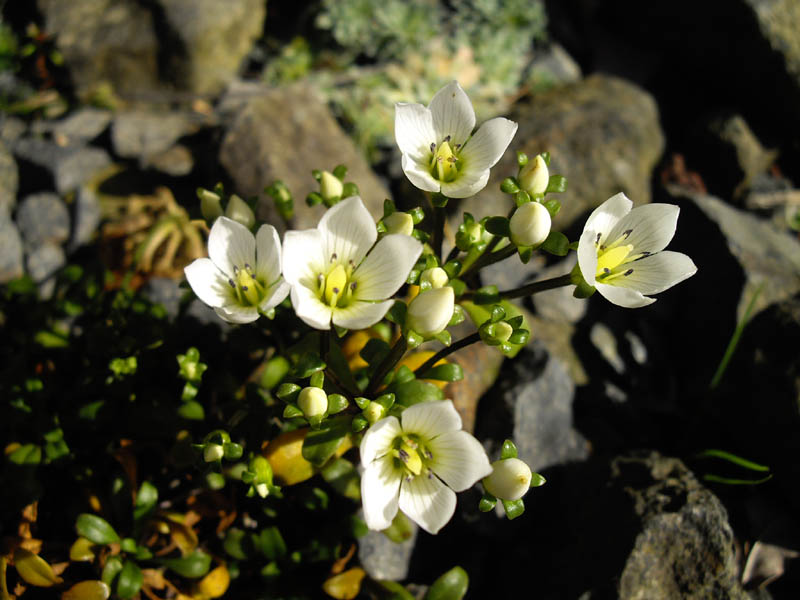
Annual or biennial from the Gentianaceae family, Gentianella saxosa is an endemic species of New Zealand, where it grows in rocky screes, coastal cliffs, and gravelly slopes exposed to the wind, from the coast to high altitudes. It prefers well-drained, poor substrates, often on dark rocks, in open and windy environments.
It forms small, loose, and spreading tufts, 5 to 15 cm in height, with branched stems tinged with brown-orange to reddish. The leaves, small, slightly fleshy and bright green, are tightly packed along the stems.
The flowers, with five widely open lobes, are pure white with slight veining, with a pale green to yellow-green center from which emerge stamens with prominently dark anthers. This graphic clarity between the white petals and the colored center is one of the most immediate attractions of the species.
In its natural habitat, its flowering extends from November to January, corresponding to the southern summer. In cultivation under French climate, it blooms in summer, from June to September depending on conditions.
Its annual or biennial nature requires allowing the seeds to mature on the plant to ensure reseeding and the plant's longevity in the garden. It germinates without particular difficulty in a well-drained, poor to moderately rich substrate; excess stagnant moisture remains the main thing to avoid. It has nothing to do with European Gentianella, often demanding on pH or dependent on specific mycorrhizae; this one is accessible and generous as long as drainage is ensured.