Perennial of the Gentianaceae family, this gentian is native to the Caucasus, where it grows in alpine and subalpine meadows, rocky slopes, and grassy screes, at altitudes of approximately 1,800 to 3,000 meters, on various substrates.
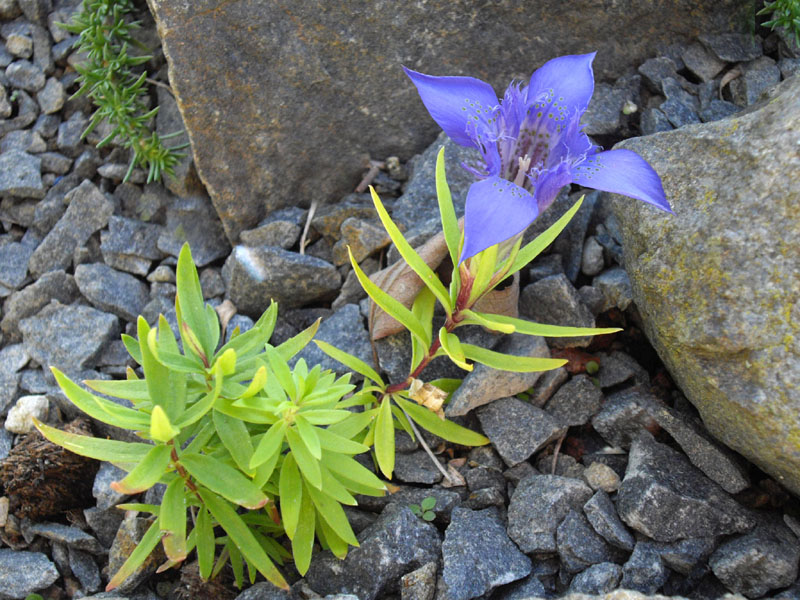
It forms small, low, and spreading clumps, with reclining-ascending stems of 10 to 20 cm, bearing narrowly lanceolate leaves, a bright slightly shiny green, arranged in close whorls that give the plant a dense and almost brush-like appearance.
The flower, solitary and terminal, is a bright lavender blue to violet blue, with five widely spread lobes, almost flat, giving it an unusual openness in the genus. The center of the tube displays brown-purple blotches and dark dots, framed by finely lacerated white fringes, a remarkable and immediately visible ornamental feature. The bases of the lobes are slightly twisted, giving rise to the name paradoxa.
In its natural habitat, its flowering extends from August to September. In cultivation, it blooms in September-October.
It is cultivated in acidic to neutral, humus-rich, well-drained soil, in sunny to semi-shaded exposure. Relatively accommodating among autumn gentians, it is suitable for rockeries and gravel gardens, provided some coolness is maintained in summer.