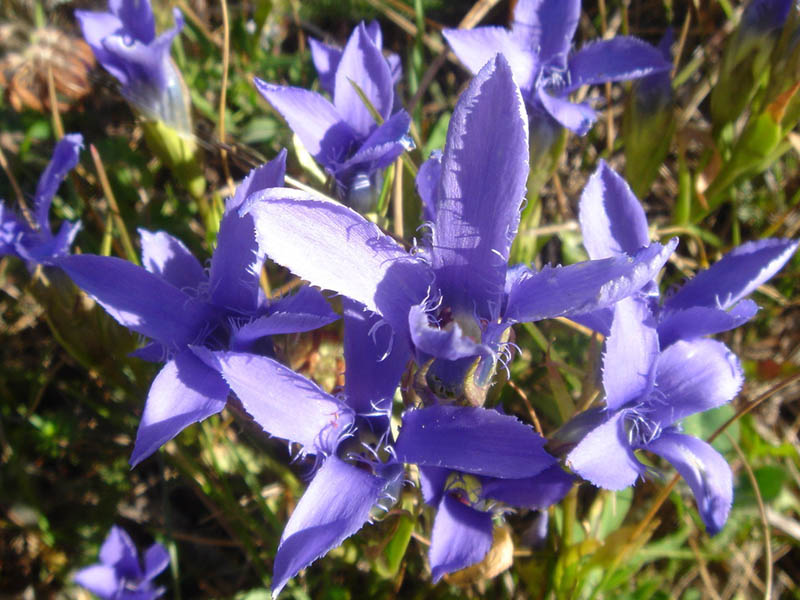
photographed in the Alps
photographed in the Alps
Annual or biennial of the Gentianaceae family, the fringed gentian is present in a large part of temperate and mountainous Europe, from the Alps and the Pyrenees to the Carpathians and the massifs of Central Europe. It frequents dry calcareous grasslands, sunny edges, slopes, and poor pastures, from hills up to about 2,000 meters in altitude.
The plant forms small upright and branched clumps, 10 to 30 cm in height, with often reddish stems. The leaves, opposite, are narrowly lanceolate, of a medium green.
What immediately distinguishes this species is the dense and spectacular fringe that borders each of its four floral lobes: long whitish to purplish fringes, clearly visible, give the flowers a vaporous and almost torn appearance, which the photograph perfectly captures. The corollas, of a bright and deep blue-violet, open widely in the sun and close in overcast weather.
In its natural habitat, its flowering extends from August to October, making it one of the latest species of calcareous grasslands.
The cultivation conditions are similar to those of Gentianella campestris: poor, calcareous, well-drained soil, fully sunny exposure, sowing in autumn directly in place on undisturbed living soil. The probable dependence on the soil's mycorrhizal networks makes sowing in sterile substrate very uncertain. It only maintains itself by freely reseeding.