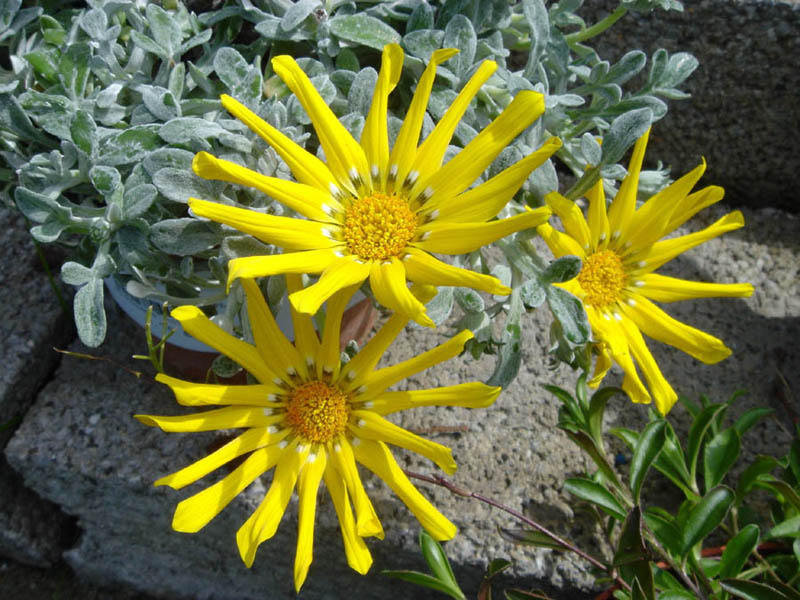
Perennial of the Asteraceae family, this natural variety of Gazania rigens is native to the coastal and subcoastal regions of South Africa, where it colonizes dunes, coastal sands, and well-drained rocky terrains, in full sun exposure.
What immediately distinguishes this variety from the type is its densely tomentose foliage, a bright silvery-gray, forming a low and compact tuft of 15 to 25 cm. The entire or slightly lobed leaves are covered with a white felt on both sides, a characteristic that gives it remarkable resistance to drought and saline wind.
The capitula, carried on short erect peduncles, are a bright and clear yellow, with narrow, radiating ligules marked with a small white spot at their base, a discreet but characteristic detail visible up close. Like all gazanias, the flowers close at night and in cloudy weather.
In its natural habitat, its flowering extends from spring to early summer. In cultivation under mild or Mediterranean climate, it can bloom from March to July.
It requires a perfectly drained soil, poor to moderately fertile, in full sun, and withstands summer drought well. Its hardiness is limited: it tolerates light transient frosts down to about -5°C, only if the soil is dry. In regions with wet and cold winters, it does not persist in open ground and must be brought into a cold greenhouse or protected under a frame. In a Mediterranean or mild oceanic climate, it can persist for several years in a well-exposed rock garden.