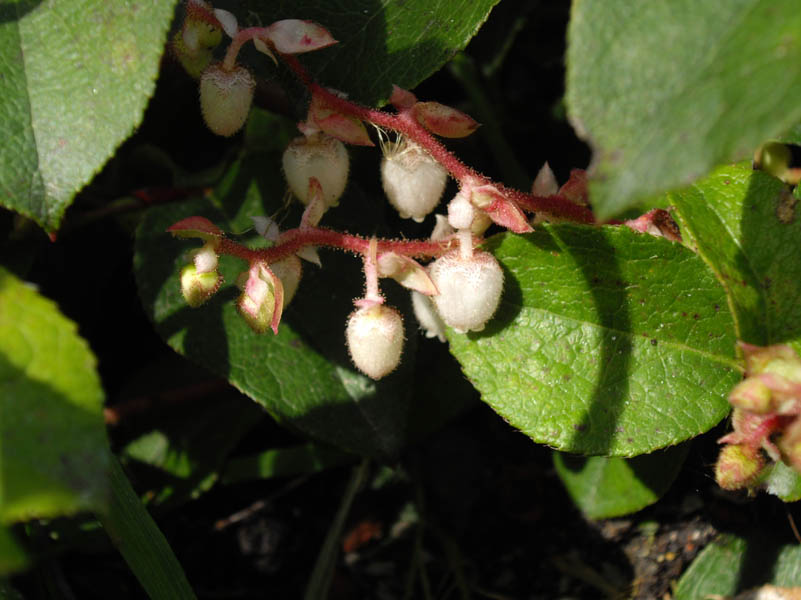
Shrub of the Ericaceae family, Gaultheria shallon is native to the west coast of North America, from California to British Columbia. It inhabits coniferous undergrowth, coastal heaths, and shaded banks, on acidic, fresh to moist soils rich in organic matter.
It forms vigorous and dense bushy masses, from 60 cm to 1.5 meters in height depending on conditions, spreading by stolons to gradually form large colonies. The leaves are large, oval, leathery, and evergreen, dark green and slightly shiny, with pronounced veins, giving them a notable architectural presence throughout the year.
The flowers, small and bell-shaped, pale pink to pinkish-white, are arranged in drooping clusters and appear in spring. They give way to dark purple to black, fleshy and persistent berries, which the indigenous peoples of the northwest coast consumed fresh or dried, constituting an important food resource.
In its natural habitat, its flowering extends from April to June. In cultivation, it generally occurs in May.
It requires acidic, humus-rich, and fresh soil, in shade or partial shade, without limestone. Hardy and covering, it is suitable for large acidic woodland gardens, but its vigor can make it invasive in confined spaces.