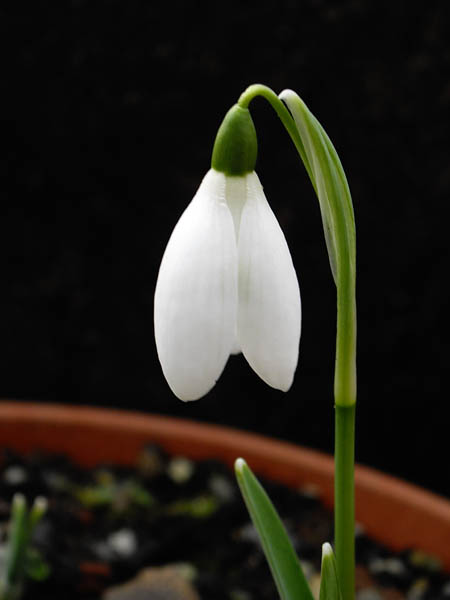
Bulbous perennial of the Amaryllidaceae family, the snowdrop is native to central and southern Europe, from the Pyrenees to the Carpathians and the Caucasus, naturalized in much of western Europe. It inhabits fresh deciduous woodlands, moist meadows, shaded banks, and grassy slopes, often on calcareous or neutral soils, from the plains up to about 2,000 meters in the mountains.
It forms small clumps of 10 to 20 cm, with linear, glaucous, erect leaves that emerge simultaneously with the floral stems at the end of winter. The solitary, pendulous flower consists of three pure white, spreading outer tepals, and three shorter inner tepals marked with a green U-shaped spot at their tip, a constant and diagnostic feature of the species.
In its natural habitat, its flowering extends from January to March depending on altitude and exposure. In cultivation, it can bloom as early as late January in mild regions.
It thrives in fresh, humus-rich, well-drained soil, in partial shade under deciduous trees. Dividing the clumps after flowering, "in the green," is the most effective method for propagation. Known since antiquity, it is mentioned in traditional pharmacopoeia; an alkaloid it contains, galantamine, is now used in the treatment of Alzheimer's disease.